Guitar Tuition in Malaysia
Guitar tuition in Malaysia runs along three streams, each coached one tutor to one student. Acoustic handles open chords, strumming, campfire and busking. Electric handles lead lines, pentatonic and blues scales, bends and riffs. Classical handles nylon-string fingerstyle, the p-i-m-a right hand and staff reading. Contemporary players follow Rockschool RSL Rock & Pop Guitar (Debut + Grade 1-8) or Trinity College London Rock & Pop Guitar (Initial + Grade 1-8), and neither gates on theory. Classical players follow ABRSM Classical Guitar (Grade 1-8 + ARSM / DipABRSM), where a Grade 5 Theory pass is required before Grade 6.
What is Guitar Tuition?
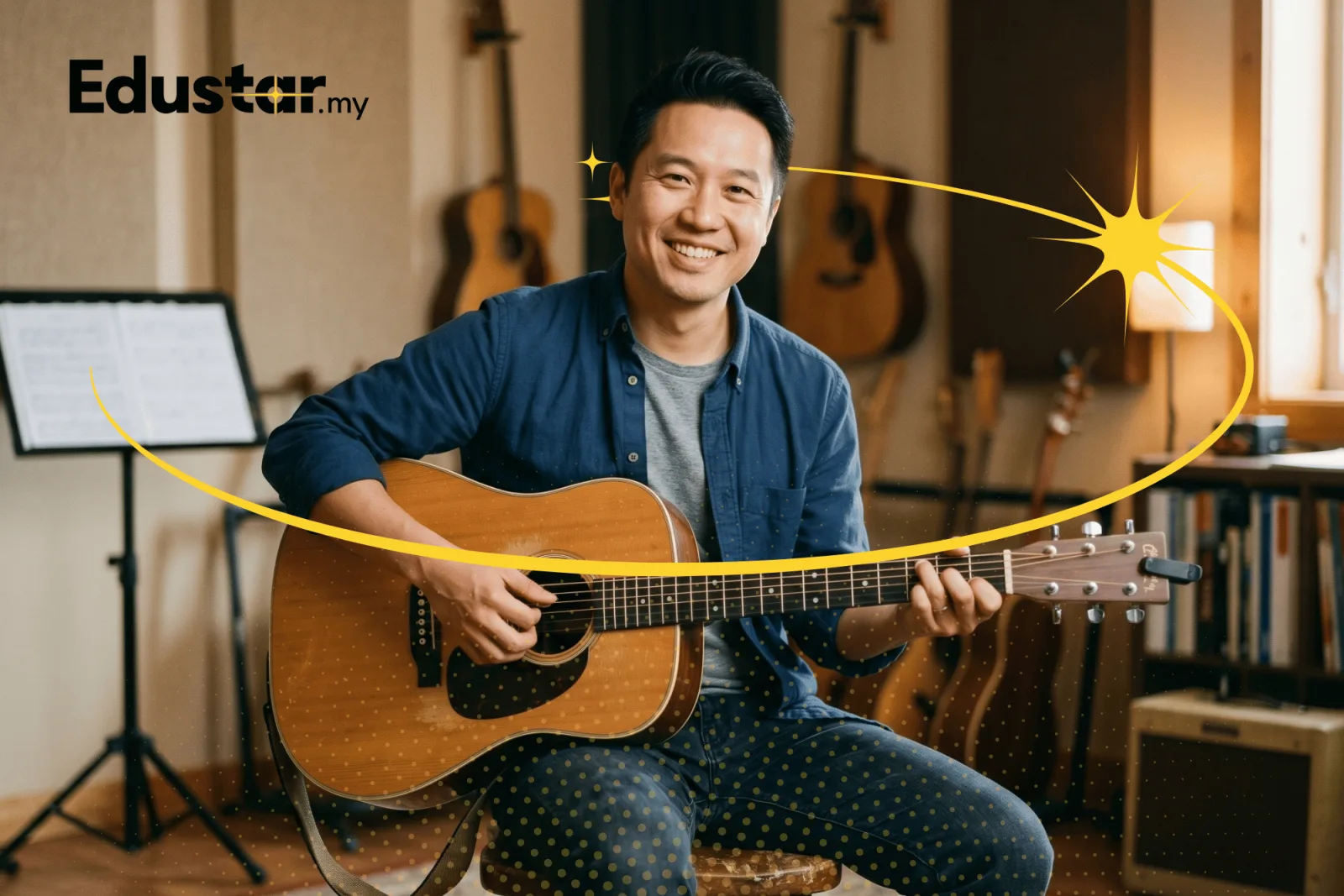
A guitar education in Malaysia turns on one fork that colours everything after it: which of three instruments the player picks up. Acoustic steel-string carries folk, singer-songwriter and pop. Electric carries rock, blues, jazz and metal. Classical nylon-string carries the Carcassi / Sor / Tárrega / Bach repertoire. Lessons run one tutor to one student, week in and week out, and each stream then locks onto its own grade ladder. Two contemporary boards let a player climb with no theory prerequisite: Rockschool RSL Awards Rock & Pop Guitar (Debut + Grade 1-8, where Grade 6-8 carry UK UCAS tariff points and a DipRSL diploma tier sits on top) and Trinity College London Rock & Pop Guitar (Initial + Grade 1-8, on the 2024-2027 syllabus cycle). The classical board moves on a different track: ABRSM Classical Guitar (Grade 1-8 + ARSM / DipABRSM / LRSM / FRSM) makes a Grade 5 Theory pass the gate to Grade 6 and above, with exams sat at Malaysia centres in KL, Petaling Jaya, Penang, Ipoh, Johor Bahru, Kuching and Kota Kinabalu. Yamaha Music (Malaysia) Sdn Bhd runs a parallel route through its Yamaha Music Education System (YMES), offering the Junior Guitar Course for children and the Popular Guitar Course for teens and adults, graded on the Yamaha Grade 13-6 scale, at branches in Mid Valley, 1 Utama, Sunway Pyramid, The Curve, Sutera Mall Johor and Penang. Two distinctly Malaysian uses pull demand off the grade ladder entirely. Worship-team rhythm guitar at NECF member churches (DUMC Damansara Utama Methodist Church, FGA Subang, City Harvest KL, Calvary), Hindu temple bhajan groups (Sri Mahamariamman KL, Batu Caves) and Buddhist Dharma chanting ensembles prizes chord-chart and lead-sheet fluency over any certificate. Busking is licensed: the DBKL KL Busker programme covers the Bukit Bintang pedestrian zone, Kasturi Walk at Central Market, KLCC Park and Petaling Street, while MBPP Penang (Lebuh Armenian, George Town) and MBI Ipoh (old-town heritage zone) run their own. The local canon of Joe Wings on Wings, Hillary Ang on Search, AC Mizal's solo rhythm work and M. Nasir's acoustic fingerstyle (Mentera Semerah Padi, Anak Kecil Main Api) is the repertoire any serious Malaysian player learns beside the international standards. For those reaching higher, ASWARA (Akademi Seni Budaya & Warisan Kebangsaan, Jalan Tun Ismail KL) and UiTM Faculty of Music (Shah Alam) both accept guitar as a principal study at Diploma and Degree level. Edustar matches each student to a single tutor tuned to the stream, the grade target and the real use-case, whether that is worship, busking, a Yamaha grade or an RSL diploma.
- 01Three streams mean three different instruments: acoustic steel-string, electric and classical nylon-string, each carrying its own body, string type, fretting and picking demands, and repertoire; the goal decides which one the player commits to, and the sooner that call is made the better
- 02Rockschool RSL Rock & Pop Guitar (Debut + Grade 1-8 + DipRSL) is the contemporary grade most MY studios default to for electric and acoustic players, built on rock and pop set pieces, with no theory gate at any level and UK UCAS tariff points at Grade 6-8
- 03Trinity College London Rock & Pop Guitar (Initial + Grade 1-8, 2024-2027 cycle) is the equally recognised, equally gate-free alternative to Rockschool, with Malaysia exam centres in KL, Penang, JB and Kuching
- 04ABRSM Classical Guitar (Grade 1-8 + ARSM / DipABRSM / LRSM / FRSM) is the nylon-string fingerstyle route, and the one board here that makes a Grade 5 Theory pass mandatory before Grade 6, with centres in KL, PJ, Penang, Ipoh, JB, Kuching and KK
- 05Yamaha Music School Malaysia runs its own ladder under the Yamaha Music Education System, offering the Junior Guitar Course, the Popular Guitar Course and the Yamaha Grade 13-6 scale at Mid Valley, 1 Utama, Sunway Pyramid, The Curve, Sutera Mall JB and Penang
- 06Busking the Bukit Bintang pedestrian zone, Kasturi Walk at Central Market, KLCC Park or Petaling Street calls for a DBKL KL Busker licence, which means an annual audition plus a permit card, while MBPP Penang and MBI Ipoh license their own heritage zones
- 07Worship-team rhythm guitar at NECF churches (DUMC, FGA Subang, City Harvest KL, Calvary) and temple bhajan groups (Sri Mahamariamman, Batu Caves) rewards chord-chart reading, the Nashville Number System and capo fluency far more than any grade certificate
- 08Budget roughly a year per grade: Grade 1-3 run 6-12 months apiece, Grade 4-5 about 12 months, Grade 6-8 some 12-18 months each, and that pace holds only with 45-60 minutes on the fretboard daily
- 09Local repertoire worth teaching beside the international standards includes Joe Wings' Wings rock leads, Hillary Ang's Search leads, AC Mizal's solo rhythm work and M. Nasir's acoustic fingerstyle (Mentera Semerah Padi)
- 10Edustar pairs one tutor to one student by stream, grade board and real use-case, in person across Klang Valley, Penang and Johor, or online nationwide over Zoom with tablature sharing; ASWARA and UiTM Faculty of Music pathways are supported for serious players
Who guitar tuition in Malaysia is for
We match the tutor and stream to where the student already stands: hobbyist beginners of any age, school-age Rockschool / Trinity / ABRSM track students, worship-team volunteers and busking aspirants.
Hobbyist beginners (all ages, kids 6+ through adults)
A first-time guitarist with no exam ambition who simply wants to play the songs they love. Picture a Year 1-6 child whose parent brought home a Yamaha F310, a teenager who grabbed an electric after falling down a Wings or Search rabbit hole, or an adult finally starting at 35-50 to unwind after work. The coaching settles instrument setup, open chords, a handful of strumming patterns and the four-chord-wonder repertoire (Tanya Sama Itu Hud Hud, Wonderwall, Stand By Me, plus three or four worship standards). The six-month aim is eight to ten complete songs played cleanly, and a clear-eyed call on whether a grade track is worth chasing.
- Bought a guitar months ago, still stuck on basic chord shapes, and unsure what to learn next
- YouTube tutorials feel random, with no clear order and no progress signal
- Fingers hurt for the first three weeks and the student almost gave up
- Cannot decide whether to stay acoustic or switch to electric for the music they actually like
School-age Rockschool / Trinity / ABRSM grade track (Year 4-6 + Form 1-5)
A player with one to three years already behind them, and a parent who now wants a structured, certificate-backed pathway. Most enter at Rockschool Debut or Grade 1 (electric or acoustic) or ABRSM Grade 1 (classical). The coaching drills the full grade syllabus (set pieces, technical exercises, scales and arpeggios for ABRSM, ear tests, sight-reading, and improvisation for Rockschool or Trinity) against an annual exam date. The target is Grade 5 around Form 2-3 and Grade 8 by the Form 5 SPM year, with the Grade 6-8 UCAS tariff feeding overseas university applications.
- Played for two years but has no clear next grade target, and has sat at the same level for a year
- Cannot tell whether Rockschool, Trinity or ABRSM is the right syllabus for them
- SPM year is approaching and guitar practice is dropping to 10 min/day, so it needs to hold steady or pause cleanly
- Wants to apply to a UK university with the UCAS guitar tariff but does not know which grade qualifies
Worship-team volunteers (NECF churches + Hindu temple bhajan + Buddhist Dharma music)
A volunteer serving a worship rotation at a NECF member church (DUMC Damansara Utama Methodist, FGA Subang, City Harvest KL, Calvary Church KL, Acts Church PJ), a Hindu temple bhajan group (Sri Mahamariamman KL, Batu Caves) or a Buddhist Dharma ensemble. The real demand is congregation-ready rhythm guitar, and a grade certificate is beside the point. The coaching builds chord-chart reading, the Nashville Number System (so a 1-5-6-4 transposes the instant the worship leader shifts key), capo management for the keys worship leaders actually sing in (capo 2, 3, 4 or 5), strumming and palm-mute restraint that stays under the vocal, ear training for unrehearsed key changes, and basic acoustic amp and mic awareness.
- Can play songs in the original key yet freezes when the worship leader transposes
- Strums too loud or too busy, and keeps stepping on the vocal lead
- Cannot tell which capo position to use when the chord chart sits in a hard key
- Wants to graduate from playing only chord-chart songs to reading lead sheets and transcribing fills
Busking aspirants + DBKL KL Busker audition prep
A player who wants to busk legally on KL's streets (the Bukit Bintang pedestrian zone, Kasturi Walk at Central Market, KLCC Park, Petaling Street), or in George Town (Lebuh Armenian) or old-town Ipoh. The real need is DBKL KL Busker audition prep and a polished 30-45 minute setlist that holds a moving crowd. The coaching covers setlist curation (a mix of MY pop, Malay rock and international singalongs that land on a busy walkway), busking dynamics (loud and clear enough to carry without amplification at most zones), patter for a crowd that never stops moving, instrument care against street weather, and the economics of the pitch (tip jar, payment QR, cover-versus-original balance).
- Can play 50 songs but cannot tell which subset works on a busy Bukit Bintang Saturday night
- Plays well at home yet loses volume and projection in an outdoor space
- Does not know the DBKL KL Busker audition format or how to apply for the licence card
- Worries about competing with amplified buskers and needs honest advice on whether to use a portable amp at zones that allow it
What guitar tuition covers
Three modules trace the guitar journey: beginner foundations (open chords, strumming and a 4-chord song repertoire), the intermediate band (barre and power chords, scales and Rockschool Grade 3-5), and the advanced band (improvisation, theory and Rockschool / Trinity / ABRSM Grade 6-8 + DipRSL / DipABRSM).
Beginner foundations: open chords, strumming, 4-chord songs (kids 6+, teens, first-time adults)
The first months build a working chord vocabulary and the right hand that drives it. A set of open chords plus a handful of strumming patterns, together with the canonical four-chord loop (C-G-Am-F or G-D-Em-C), already unlocks hundreds of Malaysian pop, Malay rock and worship songs. The module fits primary-school kids (aligned to the Yamaha Junior Guitar Course), teens picking up a first electric or acoustic, and adult starters alike. By the end the student has 8-10 complete songs under the fingers and is ready to sit Rockschool Debut or Grade 1.
Instrument choice and setup (acoustic steel-string vs electric vs classical nylon-string; lefty vs righty decision; budget gear list — RM 300-800 acoustic beginner, RM 600-1500 electric starter pack); tuning (standard EADGBE, electronic tuner, tuning app); open chords (C, G, D, A, E, Am, Em, Dm, F-with-thumb cheat); strumming patterns (down-up-down-up-up-down, 6/8 ballad, syncopated worship strum); 4-chord-wonder repertoire (C-G-Am-F + variations); first complete songs (Tanya Sama Itu Hud Hud, Isabella Search bridge in basic chords, Wonderwall Oasis, Stand By Me, plus 3-4 NECF-worship standard chord charts in G or D); reading chord charts (chord symbol literacy, capo position notation, Nashville Number System intro for worship students); first finger-style pattern (Travis picking for acoustic); first power chord (E5, A5, D5 — bridge to electric stream); rhythm-track recording for self-review; Rockschool Debut + Trinity Initial syllabus walkthrough.
Intermediate: barre chords, power chords, scales, Rockschool Grade 3-5 (school-age tournament-ready)
Here the fretboard opens past the first few frets. Moveable barre shapes (the F-shape and B-shape), power-chord progressions for rock and pop-punk, the five minor-pentatonic boxes and the major scale for first solos all get tightened against a metronome until the timing holds. Repertoire and technical work sit at Rockschool RSL Grade 3-5 or Trinity Rock & Pop Grade 3-5. It suits school-age players (Form 1-5, SPM ahead), committed adult intermediates, and worship-team rhythm guitarists.
Barre chords (full F-shape, A-shape, full B-shape; CAGED system overview); power chords across the neck (E5 / A5 root shapes, sliding power chords); minor pentatonic scale (5 box shapes); major scale (Ionian mode + 5 modal positions intro); blues scale (minor pentatonic + flat-5); first lead-guitar technique (hammer-on, pull-off, slide, bend half-step + full-step, vibrato); rhythm tightening (metronome 60-120 bpm, subdivision feel — 8ths, 16ths, triplets); strumming and palm-mute discipline for rock + pop-punk; alternate picking + economy picking intro; first guitar solos transcription (intro solo Hotel California, Wings Sejati intro lick by Joe Wings, AC Mizal rhythm pattern, basic Hillary Ang Search lick); reading tablature (TAB notation + rhythm marks); Rockschool Grade 3-5 set pieces + technical exercises + ear test + sight-reading drilling; Trinity Rock & Pop Grade 3-5 set pieces + session skills (improvising over a backing track); recording rhythm tracks on a phone for student self-review; introduction to Guitar Pro / TuxGuitar / Songsterr for self-study tablature.
Advanced: improvisation, theory, Rockschool / Trinity / ABRSM Grade 6-8 + Diploma
At this stage the player becomes an improviser who owns the whole neck. The CAGED system gets drilled until movement between shapes is fluent, modal harmony feeds jazz and modern worship, sweep picking, two-hand tapping and hybrid picking enter the lead vocabulary, and the senior grade set pieces get exam-ready. For classical-track students, Grade 6-8 here presumes the ABRSM Grade 5 Theory pass is already in hand. It suits teens chasing UCAS-tariff Grade 6-8 (Rockschool / Trinity), classical players at ABRSM Grade 6-8 + ARSM / DipABRSM, ASWARA and UiTM Faculty of Music audition candidates, and adults aiming at session-musician competence.
Full CAGED system across the neck (all 5 shapes, fluent movement between); modal harmony (Ionian, Dorian, Phrygian, Lydian, Mixolydian, Aeolian, Locrian + when each applies — Dorian for funk / pop-rock, Mixolydian for blues / country, Lydian for film / modern worship); modal interchange and borrowed chords; jazz harmony intro (ii-V-I, dominant alterations, tritone substitution); advanced lead technique (sweep picking, two-hand tapping, hybrid picking, legato fluency, string skipping); fingerstyle for classical track (Carcassi Op. 60 etudes, Sor studies, Tárrega Recuerdos de la Alhambra tremolo, Bach Bourrée arrangements); MY repertoire deep study (M. Nasir fingerstyle vocabulary, Joe Wings rock lead phrasing, Hillary Ang vibrato style, AC Mizal rhythm patterns); Rockschool RSL Grade 6-8 set pieces + technical exercises + improvisation + ear test + sight-reading + session skills; Trinity Rock & Pop Grade 6-8 set pieces + improvisation; ABRSM Classical Guitar Grade 6-8 set pieces + scales + arpeggios + sight-reading + aural; DipRSL / ARSM / DipABRSM diploma preparation (35-40 min recital programme + viva); recording / live performance discipline (DAW basics in Reaper or Logic for demo recording, basic mic technique for acoustic, amp tone for electric stage); ASWARA + UiTM Faculty of Music audition repertoire selection; MY busking-licence audition prep (DBKL KL Busker, MBPP Penang) including 30-minute setlist of MY + international songs.
From first call to first guitar lesson
How starting guitar tuition with Edustar runs in practice: stream choice first, syllabus matching second, weekly drilling third.
- 1
First call: stream, goal, and what is realistic
Share the student's age, where the playing sits today (never held a guitar / knows a few open chords / one to three years in / heading for a grade exam), which stream pulls at them (acoustic, electric, classical, or still undecided), and the real goal, whether that is playing for fun, a Rockschool RSL or Trinity grade, an ABRSM Classical grade, the worship team at a particular NECF church, a DBKL busking audition, or an ASWARA / UiTM tilt. Add the weekly practice time on offer and whether a guitar already sits at home. We answer honestly about what a year can deliver and which board fits the goal.
~15 min - 2
Playing diagnostic: a short recording and a fretboard check
A returning player sends a short phone video of one strummed song, one fingerpicked passage and a minute of a scale or technical exercise. From that the tutor spots the recurring faults: too much fretting-hand pressure, uneven strumming, timing that drifts, a fretting wrist sitting at the wrong angle. An outright beginner instead gets a quick five-question chat about the music they love and two or three songs to aim at over the first three months. Either way, the point is to name the two or three high-leverage things to fix in the opening eight weeks.
Before lesson 1 - 3
Matching the tutor: stream, board, temperament
For each learner we line up a tutor matched to the instrument stream (acoustic, electric, classical), the grade board (Rockschool RSL, Trinity Rock & Pop, ABRSM Classical) or a non-grade track (worship, busking, songwriting), and personality, since a child who needs patient encouragement reads very differently from an adult who wants blunt feedback. Lessons run in person across Klang Valley, Penang and Johor, or online nationwide over Zoom with tablature shared live (Songsterr, Guitar Pro files) and weekly recorded homework. For a left-handed student, the lefty-versus-righty decision gets settled in this window.
1-3 days - 4
Lesson one: tune up and a song in hand
A beginner's first hour covers setup (tuning, an action check, a basic adjustment), the first three open chords (Em-Am-D or C-G-Am-F, depending on stream), and one complete simple song by the time it ends, typically a three-chord worship standard or a Malay pop tune the child already hums. An intermediate player gets a technique reset on the two or three faults from the diagnostic, plus the first set piece from their chosen grade syllabus. Every first lesson ends with the student able to play something for the family, a real and visible win.
Lesson 1 - 5
The weekly groove: repertoire, technique, theory
Sessions run 45-60 minutes (children 30-45, teens and adults a full hour), split three ways: a repertoire slice (the current song or grade set piece), a technique slice (scales, chord-change transitions, metronome work on whatever rhythm is weak), and a theory-and-ear slice (chord-symbol reading, key signatures, interval recognition, doubly important for worship-team students). Between lessons, 30-45 minutes of daily practice carries a specific assignment: one repertoire song, one technique drill, and five to ten minutes against the metronome.
Ongoing — weekly - 6
Run-up to the exam, stage or busking audition
In the eight to twelve weeks before a Rockschool RSL, Trinity or ABRSM grade exam, lessons turn into full exam simulations: set pieces under exam conditions, technical exercises at exam tempo, ear tests and sight-reading drilled cold. Worship-team students instead rehearse the service, reading chord charts at sight, changing capo mid-song, and transposing keys under pressure. Busking-track students run the whole 30-45 minute setlist and get walked through the DBKL KL Busker audition format. ASWARA and UiTM candidates prepare the full recital programme and viva.
Final 8-12 weeks pre-event - 7
Debrief and the plan for the next grade
Within a fortnight of the exam (results take four to six weeks to come back from Rockschool, Trinity or ABRSM), tutor and student watch the exam-day recording together and map the next cycle: the repertoire shift, the next technical-exercise rung, the theory layer to add. A student stepping off the grade ladder toward performing or writing instead picks up DAW basics, a first original and a home-recording workflow. The path is re-cut every year, as the grade exams roll on or they branch into worship, busking, songwriting or band playing.
2 weeks post-exam
Things parents ask us first
Acoustic vs Electric vs Classical: the three streams and how to pick
Three different instruments call for three different studios. Acoustic steel-string is the singer-songwriter, worship and busking default, running RM 300-1500 for a usable starter (Yamaha F310, Cort AD810, Fender CD-60S), needing no amp and pressing hardest on the fingers in the first month. Electric covers rock, blues, jazz and metal, running RM 600-2000 for a starter pack (Squier Stratocaster or Yamaha Pacifica plus a small practice amp), demanding amp and cables yet easier on the fingers with more gear to manage. Classical nylon-string is the ABRSM and formal-music-school path, running RM 500-1500 (Yamaha C40, Cordoba C5), carrying a wider neck and fingerstyle only (no pick), with the Carcassi / Sor / Bach repertoire. Pick the stream by goal: worship team or busking weekends point to acoustic, a rock or pop band points to electric, and ABRSM grade exams or an ASWARA / UiTM audition point to classical. Switching streams later is possible, and it means re-learning technique for three to six months.
Rockschool RSL vs Trinity Rock & Pop vs ABRSM Classical: match the syllabus to the goal
Three grade boards carry three different repertoires. Rockschool RSL Awards Rock & Pop Guitar (Debut + Grade 1-8 + DipRSL) is the dominant contemporary syllabus in MY studios, built on rock and pop set pieces (Foo Fighters, Green Day, Muse, Coldplay), with a strong technical-exercise framework and Grade 6-8 carrying UCAS tariff points for UK university entry. Trinity College London Rock & Pop Guitar (Initial + Grade 1-8, 2024-2027 syllabus cycle) is the alternative, weighted slightly differently in repertoire, heavier on session skills, and just as recognised. ABRSM Classical Guitar (Grade 1-8 + ARSM / DipABRSM / LRSM / FRSM) is the formal classical path of Carcassi, Sor, Tárrega and Bach, with an exam covering scales, arpeggios, sight-reading and aural. Pick this way: a rock, pop, blues or jazz electric player leans to Rockschool or Trinity (a toss-up settled by the tutor's preference), a singer-songwriter acoustic player eyeing a UK university leans to Rockschool for the UCAS tariff, and a classical, ASWARA, UiTM or serious-music-school player leans to ABRSM. Mixing boards mid-track is fine, and it means re-learning the new board's technical exercises.
DBKL KL Busker licence: the rule for busking Bukit Bintang or Central Market
Busking on KL streets is not a free-for-all. DBKL (Dewan Bandaraya Kuala Lumpur) runs the KL Busker programme (launched 2013), which requires an annual audition plus a licensed card to perform legally at the designated zones: the Bukit Bintang pedestrian walk (Jalan Bukit Bintang / Pavilion Crescent), Kasturi Walk at Central Market, the KLCC Park concourse and Petaling Street. Unlicensed buskers risk DBKL enforcement, from warnings to instrument confiscation in repeat cases. The audition is straightforward, a short live performance before a DBKL panel, and the bar is a player who can run 3-5 songs front-to-back, hold pitch and hold an audience. Other councils run their own programmes, with MBPP Penang covering Lebuh Armenian and the George Town heritage zone and MBI Ipoh covering the old-town heritage zone. Edustar coaches teaching busking-track students will explicitly prep the DBKL audition setlist and permit-application workflow. Busking without a licence is real income at real legal risk.
Worship-team guitar: chord chart, Nashville Number System and capo literacy beat grade certificates
When the student's real goal is rhythm guitar at a NECF member church (DUMC Damansara Utama Methodist Church, FGA Subang, City Harvest KL, Calvary Church KL, Acts Church PJ), a Hindu temple bhajan group (Sri Mahamariamman KL, Batu Caves) or a Buddhist Dharma music ensemble, the skills that matter are chord-chart reading, the Nashville Number System (writing progressions as 1-5-6-4 so transposing on the fly is instant), capo position management (most worship leaders sing in keys that need capo 2, 3, 4 or 5 to make the shapes playable), ear training to follow a worship leader's unrehearsed key change, and palm-muting and strumming discipline that supports a vocal lead without overplaying. None of this appears on a Rockschool or ABRSM syllabus. A worship-track tutor at Edustar builds the whole skill set in three to six months, usually faster than a grade track because the target is congregation-ready rather than exam-ready. Grade exams remain possible in parallel, and the worship-team competency stands on its own.
Lefty vs righty: decide early, especially for kids under 10
Roughly 10-12% of MY kids are left-handed, and only a small fraction of guitar players play left-handed (the famous exception is Paul McCartney, while Jimi Hendrix played a flipped right-handed guitar). Two real choices sit here. The first is to buy a true left-handed guitar, which is possible though the model range is smaller and 15-30% more expensive in MY shops (BENTLEY Music, GuitarStore.com.my and RM Music carry limited lefty stock in the Yamaha and Squier ranges). The second is to learn right-handed despite being left-handed, which is what about 60-70% of MY lefty players actually do, because the gear market is bigger and group-class compatibility is easier. Edustar's steer: an under-10 left-handed child who is strongly left-dominant in fine motor tasks should buy lefty if the budget allows, while a teen or adult discovering guitar should learn righty unless the discomfort is severe in the first month. The decision is permanent, since re-learning takes six to twelve months, so it earns a clear conversation in the first free-consultation call.
12 months per grade is the honest timeline: faster only with daily practice
A realistic rule of thumb across all three boards (Rockschool RSL, Trinity Rock & Pop, ABRSM Classical): Grade 1-3 takes 6-12 months each at 30-45 minutes of daily practice, Grade 4-5 about 12 months each at 45-60 minutes daily, and Grade 6-8 some 12-18 months each at 60-90 minutes daily plus regular performance practice. The DipRSL / ARSM / DipABRSM diploma runs 18-24 months beyond Grade 8 and includes a 35-40 minute recital programme. A student starting at age 8 with consistent daily practice can realistically reach Rockschool Grade 5 by age 14 (Form 2) and Grade 8 by the Form 5 SPM year. Adults learn slightly slower in technical-exercise speed and compensate with theory grasp and practice discipline. Edustar coaches set a clear annual milestone (for example, Rockschool Grade 3 by next October) and adjust when life intervenes (SPM year, work, instrument access), so the 12-month-per-grade rhythm stays the structural target rather than an arbitrary push.
What guitar tuition with Edustar covers
An honest scope with no guaranteed grade pass, only structured year-round coaching aligned to Rockschool, Trinity and ABRSM, plus worship, busking and songwriting tracks.
Age 6 – adult
From a six-year-old's first open chord to an adult diploma recital
Rockschool + Trinity + ABRSM
Three grade boards coached — RSL Rock & Pop, Trinity Rock & Pop, ABRSM Classical
3 streams
Acoustic, electric and classical guitar all taught
Nationwide
In person or online over Zoom with tablature shared live
How guitar lessons map onto the Malaysian music-grade ladder
From first open-chord lessons to an ASWARA / UiTM Faculty of Music audition, a multi-year pipeline that can branch at any point into worship-team, busking or band performance.
- 01
Age 6-9 (first exposure)
The first lessons usually sit a child on a 3/4-size acoustic or a Yamaha JR1, aligned to the Yamaha Junior Guitar Course. The work is small and concrete: the first open chords (Em, Am, D, G), a simple downstrum, and three or four complete songs by the end of year one. A ChordBuddy or similar finger-guide is fine for the first three to six months when it keeps a small hand from giving up. JustinGuitar's free Beginner Course on YouTube scaffolds home practice between lessons. No grade exam yet, since the only goal is making the playing habit stick.
- 02
Year 4-6 (primary Rockschool / Trinity Initial-Grade 1-3)
The child graduates to a full-size guitar (acoustic, or a 1/2-size electric). The grade ladder opens here, whether Rockschool Debut through Grade 1, 2, 3, or Trinity Initial through Grade 1-3, or ABRSM Classical Grade 1-3. A first exam, usually Rockschool Debut, lands around age 10-11, then one grade a year after that. Yamaha Music School's Junior Guitar Course runs the same stage at Yamaha Grade 13 to 11. A few MY primary schools (SK and private) run an informal guitar club, though rarely with a structured grade curriculum, and the 1-to-1 lesson fills that gap.
- 03
Form 1-3 (lower secondary, Rockschool / Trinity Grade 3-5)
The middle grades arrive: Rockschool RSL or Trinity Rock & Pop Grade 3 through 4 and 5, or ABRSM Classical Grade 3-5. Barre and power chords lock in, the minor pentatonic boxes unlock the first solos, and the first lead moves of bends and vibrato start to sing. Classical-track students meet their first multi-voice pieces (the introductory Carcassi Op. 60 etudes). First school and church performance slots appear, and many students begin their NECF worship-team rhythm-guitar service in exactly this window.
- 04
Form 4-5 (SPM years, Rockschool / Trinity / ABRSM Grade 5-7)
The senior grades coincide with the SPM crunch: Rockschool / Trinity Grade 5 through 6 and 7, or ABRSM Classical Grade 5-7. Grade 6-8 on Rockschool and Trinity carry UCAS tariff points that matter for a student eyeing a UK university. SPM year often squeezes practice to 20-30 minutes a day for six months, and the disciplined move is to freeze new repertoire and keep only the technical exercises ticking over, then resume after the exams. ASWARA and UiTM Faculty of Music audition prep can begin here when a conservatory route is the plan.
- 05
Pre-U / Adult improver / Diploma track
The diploma tier opens: Rockschool DipRSL or ABRSM ARSM / DipABRSM / LRSM, each built on a 35-40 minute recital programme plus viva and supporting paperwork. ASWARA's Diploma and Degree in Muzik (guitar as principal study) and UiTM's Diploma and Bachelor of Music (Composition / Performance / Music Education) take serious classical or popular-music players. For adults outside the school system, the same stage might mean DBKL KL Busker audition prep, worship-team lead-sheet literacy, or original songwriting and home recording on DAW basics (Reaper, Logic, GarageBand).
- 06
Performance / session-musician / hobby ceiling
Three honest end-states branch from here. A gigging player works the local pub, wedding and event circuit and session dates, in a scene clustered around KL (No Black Tie, Merdekarya, KLPAC), Penang (China House, Hin Bus Depot) and Johor Bahru's small live rooms. A committed worship guitarist deepens across rhythm and lead, fluent in several churches' liturgical styles. An adult hobbyist settles at a comfortable ceiling of 50-plus songs, jams with friends and no further grade ambition. All three are valid, and Edustar never pushes the grade ladder on a student who does not want it.
Frequently Asked Questions
What Malaysian parents, students and adult guitar learners most want to know.
Start Guitar tuition with Edustar
Book a no-cost skill check and we line up a guitar tutor within 1-3 days, across Rockschool RSL, Trinity Rock & Pop, ABRSM Classical, worship-team and busking tracks, in person or online right across the country.
- Free needs assessment plus a short technique diagnostic
- Tutor matched by stream (acoustic / electric / classical), grade board and temperament
- Sequenced curriculum: open chords, then barre and power, then grade-exam set pieces, then diploma and improvisation
- Rockschool RSL + Trinity Rock & Pop + ABRSM Classical exam prep
- Worship-team chord-chart, Nashville Number System and DBKL KL Busker audition prep supported
- Home or online, nationwide
Edustar — Malaysian private tuition, KPM-aligned tutors.