Drum Tuition in Malaysia
Drum tuition in Malaysia coaches the kit as an instrument of coordination and time. There is no melody to read and no chord to voice, so every lesson goes into the hands, the feet and the clock. A weekly one-to-one session usually runs two tracks in parallel: a graded route under Rockschool (RSL Awards) Drums Debut–8 + DipRSL or Trinity Rock & Pop Drums Initial–8, and an applied route for worship rotations, school drumlines and gigging bands. The hands earn the PAS 40 Essential Rudiments on the pad before four-limb grooves land on an acoustic or an apartment-friendly electronic kit.
What is Drum Tuition?
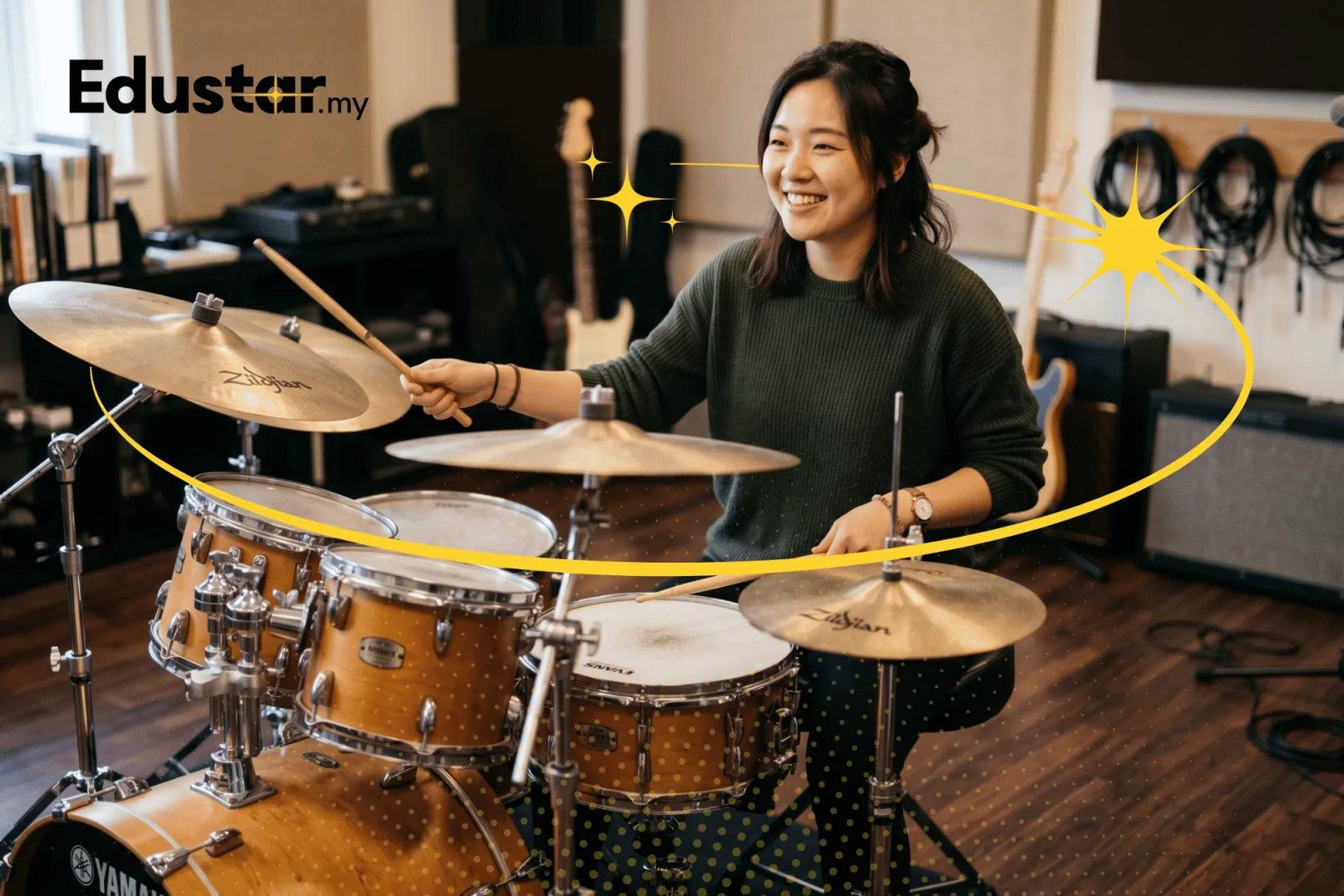
Drum tuition in Malaysia asks one weekly lesson to carry three separate jobs at once, because the kit itself hands each limb a different task in the same bar. The pad layer works the PAS (Percussive Arts Society) 40 Essential Rudiments: the Single Stroke Roll, Double Stroke Roll, the Single Paradiddle family, the Flam family, the Drag family and the Ratamacue family, taken straight from George Lawrence Stone's Stick Control for the Snare Drummer (1935, still the foundation text every teacher returns to), with the Moeller whip-stroke added later for power and stamina. The coordination layer fuses those hands and feet into four-limb independence, with kick, snare, hi-hat and ride swapping duties across rock, funk, pop, gospel, jazz and Latin feels. The applied layer aims all of it at one chosen destination. That may be Rockschool (RSL Awards) Drums Grades Debut–8 + DipRSL (Technical Exercises + 3 Performance Pieces + Technical Studies + Supporting Tests covering sight-reading, improvisation, quick-study and ear test + General Musicianship Questions), or Trinity Rock & Pop Drums Grades Initial–8 (3 Songs across Trinity selection + Session skills + Technical focus, plus optional Music knowledge, where Grade 6+ earns UCAS tariff points for UK / Commonwealth university entry), or a non-graded applied track for a KL / PJ worship team (FGA, DUMC, City Harvest KL, Calvary Church, SIBKL, running a 4-piece minimum kit, Nashville Number System chord charts and Ableton click + stem playback) and MSSM-recognised school drumlines (snare line + tenor line + bass drum line). Where that kit physically lives is decided by Malaysian housing: around 95% of Klang Valley high-rise apartments cannot host an acoustic kit even after low-volume cymbals (Zildjian L80, Sabian Quiet Tone) and mesh heads, because the kick vibration still travels through the floor slab. So the standard first kit is a Roland V-Drums (TD-02 / TD-07 / TD-17) or Yamaha DTX (DTX402 / DTX452 / DTX6) electronic kit with mesh heads, played through closed-back headphones (Audio-Technica ATH-M50x or Vic Firth SIH2 isolation cans). Yamaha Music Malaysia, Bentley Music KLCC and Penang Music Centre all stock these kits new. When a student wants genuine acoustic feel, Edustar coaches book studio time at KLPAC (Kuala Lumpur Performing Arts Centre, Sentul), DPAC (Damansara Performing Arts Centre), penangpac or an independent rehearsal room. For anyone aiming at a professional career, ASWARA (Akademi Seni Budaya & Warisan Kebangsaan, under MOTAC) runs the only Diploma + B.Mus.Hons Percussion + Drum Set principal-study route inside the country.
- 01Rockschool (RSL Awards) Drums Debut–8 + DipRSL syllabus structure: Technical Exercises + 3 Performance Pieces + Technical Studies + Supporting Tests (sight-reading, improvisation, quick-study, ear test) + General Musicianship Questions; there is no Grade 5 Theory gate the way ABRSM classical imposes one
- 02Trinity Rock & Pop Drums Initial–8 syllabus: 3 Songs (Trinity selection + Session skills + Technical focus) + Session skills (playback / improvising) + optional Music knowledge; from Grade 6 upward the UCAS tariff counts toward UK / Commonwealth university entry
- 03The PAS 40 Essential Rudiments belong to every drummer: Single Stroke Roll, Double Stroke Roll, Single Paradiddle (plus inverted, double, triple variants), Flam (plus Flam Tap, Flam Accent, Flam Paradiddle, Pataflafla, Swiss Army Triplet), Drag (plus Drag Paradiddle #1, #2, Single Dragadiddle, Lesson 25), Ratamacue (plus Double, Triple), and the 5/6/7/9/10/11/13/15/17 stroke rolls
- 04The canonical hand-development texts stay Stick Control (George Lawrence Stone, 1935) and Stick Control for the Snare Drummer; a daily quarter-hour on them grows the wrist and finger control that nothing else supplies
- 05Moeller technique (Sanford A. Moeller, 'The Moeller Book') is the whip-stroke method behind real power, endurance and tempos above 180 BPM, and it underpins both jazz independence and metal speed
- 06The apartment reality is blunt: about 95% of KL / PJ high-rise units cannot host an acoustic kit even with mesh heads and low-volume cymbals (Zildjian L80, Sabian Quiet Tone), since the vibration leaks through the floor, so an e-drum with headphones is the default first-kit call
- 07First-kit shopping in MY: Roland V-Drums TD-02 (entry RM 2,500-3,500), TD-07 / TD-07KV (RM 5,000-7,000), TD-17 (RM 8,000-12,000), TD-27 / TD-50 (pro tier); Yamaha DTX402 (entry RM 2,000-2,800), DTX452 (RM 3,000-4,000), DTX6 (RM 6,000-9,000), stocked by Yamaha Music Malaysia, Bentley Music KLCC and Penang Music Centre
- 08Worship-team drum demand (NECF Malaysia plus KL evangelical churches FGA, DUMC, City Harvest KL, Calvary Church, SIBKL) runs on a 4-piece minimum (kick + snare + hi-hat + ride), Nashville Number System chord-chart reading, an Ableton click track with stem playback and an in-ear monitor mix; this applied curriculum runs without any Rockschool / Trinity grade
- 09MSSM marching band (school marching band) is a KPM-recognised co-curricular activity built from snare line + tenor line + bass drum line + cymbal pairs, alongside kompang ensembles that perform for Hari Raya and majlis rasmi
- 10ASWARA (Akademi Seni Budaya & Warisan Kebangsaan, MOTAC) offers a Diploma + B.Mus.Hons Percussion + Drum Set principal, the home-based tertiary route, while KLPAC, DPAC and penangpac host regular drum and percussion masterclasses
- 11One drum coach stays with the student and calibrates to the chosen goal, whether that is Rockschool, Trinity, a worship rotation or the school drumline; in person across Klang Valley, Penang and Johor, or online nationwide over Zoom with an overhead kit cam, a shared click and Pro Tools / Logic / Ableton stems
Who Drum tuition in Malaysia is for
We match the coach and the curriculum to where the player already stands: kids 8+ meeting their first kit, worship-team volunteers, Rockschool / Trinity grade aspirants, and apartment-bound e-drum learners.
Kids 8+ — first-kit beginners (Year 2-6)
A child sitting at the kit for the first time. The rhythmic instinct is usually visible already, in the tapping along to songs and the drumming on furniture, and the family is ready to commit to an instrument. Coaching covers matched grip, posture and foot technique, PAS rudiments 1-10 with a daily Stick Control warm-up, the basic 4/4 rock beat, first songs at 60-90 BPM, metronome discipline and a first sitting at Rockschool Drums Debut / Grade 1 or Trinity Rock & Pop Drums Initial / Grade 1. It is open to SK / SJK(C) / SJK(T) / private-school / homeschool kids. The goal stays simple: love the instrument, build coordination and timing, and sit a first grade exam by Year 4-5 if the child is keen.
- The family lives in a kondominium and cannot tell whether to buy acoustic or e-drum
- The child is enthusiastic but has no idea where to begin with rudiments or reading notation
- The school music programme exists yet never teaches the drum kit specifically
- The parent wants a structured progression but is unsure between Rockschool, Trinity and the Yamaha JDC pathway
Worship-team volunteers (KL + PJ church drummers, ages 14-50+)
A teen or adult who already plays casually and has been asked, or wants, to join the worship-team rotation at a KL / PJ evangelical church (FGA, DUMC, City Harvest KL, Calvary Church, SIBKL, FGT, Calvary Convention Centre and the like). The work centres on 4-piece kit fundamentals (kick + snare + hi-hat + ride), reading a Nashville Number System chord chart, locking to a click track, Ableton / Multitracks stem playback, an in-ear monitor mix and the dynamics language of contemporary worship (soft verse, full chorus, pulled-back bridge, modulation lift). Inside 6-12 months the drummer is ready for a rotation slot, with feel and tempo discipline still sharpening after that.
- Already plays casually yet cannot stay locked to a click track through a full 4-5 song set
- The worship leader passes a chord chart at sound check and the drummer cannot read it
- The stem-playback rig and in-ear monitor mix are unfamiliar territory, with no prior Ableton experience
- The dynamics stay flat, with every chorus hit at the same energy as every verse
Rockschool / Trinity grade aspirants (Form 1-5 + adult improvers)
A player one to three years in, now past the beginner stage and wanting the structure of a graded route: Rockschool (RSL Awards) Drums Grades 2-8 + DipRSL or Trinity Rock & Pop Drums Grades 2-8 with the UCAS tariff from Grade 6. Coaching runs the whole syllabus (Technical Exercises + Performance Pieces + Technical Studies + Supporting Tests for Rockschool; 3 Songs + Session skills + Music knowledge for Trinity), the mock-exam discipline and the exam-day logistics at the MY centre. It suits committed teens aimed at UK / Commonwealth university entry and adult improvers who want an outside reading of where their playing truly stands.
- Plays well but has no objective verification of level, and wants the graded record
- Cannot decide between Rockschool and Trinity, and which pathway fits better
- The sight-reading and ear-test components lag behind the performance pieces
- Stuck against a Grade 3-4 ceiling, where rudiments, reading and 16th-note feels all need a lift to break through
Apartment-bound e-drum learners (KL / PJ / Cyberjaya / Putrajaya residents, all ages)
A family or adult in a high-rise kondominium where an acoustic kit is simply a non-starter. The decision is already made, so it will be an electronic kit (Roland V-Drums TD-02 / TD-07 / TD-17 or Yamaha DTX402 / DTX452 / DTX6) with headphones (Audio-Technica ATH-M50x, Vic Firth SIH2 isolation cans). The curriculum matches what acoustic students receive, covering rudiments, beats, fills and grade pieces, and adds the quirks only an e-kit raises: mesh-head tension, hi-hat controller sensitivity, cymbal chokes, picking module sound banks and recording out to Logic / GarageBand / Ableton over USB or an audio interface. A learner can reach grade or worship level this way without an acoustic kit ever entering the home.
- Just bought a Roland TD-17 or Yamaha DTX6 and cannot dial in feel and sound bank
- Wants to record cover videos at home and needs the USB-to-DAW workflow explained
- An acoustic-trained coach dismisses e-drum as 'not real drumming', so a coach who treats e-drum as a primary instrument is needed
- Worries the e-drum stick rebound will not carry over to an acoustic kit, when in practice modern Roland and Yamaha mesh heads bounce realistically and transfer fine
What drum coaching covers
Three modules trace the drumming road: beginner foundations (four-limb independence, 8th-note beats, PAS rudiments 1-10), the intermediate band (Rockschool / Trinity Grade 3-5 territory with fills, ghost notes and 16th-note vocabulary), and the advanced band (Rockschool Grade 6-8 + DipRSL, jazz independence, Afro-Cuban and Brazilian Latin).
Beginner foundations — 4-limb independence + 8th-note beats + PAS rudiments 1-10 (Year 2+ kids and first-time adults)
The first beats grow out of grip, posture, a small set of rudiments and the plainest rock and pop time-feel. The order of work shadows Rockschool Drums Debut / Grade 1 / Grade 2 or Trinity Rock & Pop Drums Initial / Grade 1 / Grade 2, and it serves a child who only wants to play worship sets or hold a place in the school drumline equally well.
Matched grip vs traditional grip choice (matched for kit, traditional for marching snare line); throne height + posture + foot technique (heel-down vs heel-up); reading drum notation (snare on middle line, kick on bottom space, hi-hat above staff) and basic 4/4 time signature; PAS 40 rudiments 1-10 — Single Stroke Roll, Double Stroke Roll, Single Paradiddle + inverted + double + triple, Flam, Flam Tap, Flam Accent, 5-stroke roll; Stick Control (George Lawrence Stone) daily 15-minute warm-up routine — pages 5-9 the universal starting block; basic rock beat (kick on 1+3, snare on 2+4, hi-hat 8th notes), basic pop beat variants, basic 6/8 ballad feel; first songs at quarter-note tempo 60-90 BPM (Rockschool Debut/G1 selection — typical pieces: Seven Nation Army, Smoke on the Water simplified, We Will Rock You); first fills (4-bar phrasing — three bars of groove + one bar fill); metronome discipline from day one — practising without a click is the single biggest beginner mistake; ear training for tempo recognition (60 / 90 / 120 / 140 BPM benchmarks).
Intermediate — Rockschool / Trinity Grade 3-5 + fills + ghost notes + 16th-note vocabulary (Year 6+ and Form 1-3 students)
This is the stage where a casual kit player turns into a grade-exam drummer. Coaches run the Rockschool Grade 3-5 syllabus (Technical Exercises of rising difficulty + 3 Performance Pieces + Technical Studies + Supporting Tests) or its Trinity Rock & Pop Drums Grade 3-5 counterpart. Ghost notes, dynamics and a 16th-note funk vocabulary unlock the styles the grade pieces draw on, from Stevie Wonder and James Brown to Red Hot Chili Peppers and Foo Fighters.
PAS rudiments 11-25 — Single Paradiddle-Diddle, Triple Stroke Roll, 6/7/9-stroke rolls, Multiple Bounce Roll (concert / press roll), Flam Paradiddle, Pataflafla, Swiss Army Triplet, Drag, Drag Paradiddle #1 and #2, Single Dragadiddle, Lesson 25, Ratamacue, Single + Double + Triple Ratamacue; 16th-note rock + funk feels (eighth-on-the-hi-hat with kick + snare displacements), ghost-note snare technique (kept very low volume, played between accented backbeats — see Bernard Purdie shuffle, David Garibaldi linear funk); 16th-note hi-hat with quarter-note kick (Latin / disco / dance feel); basic 4-way coordination (kick + snare + hi-hat + ride — typical for Rockschool G4-G5 jazz pieces); drum fills — single-stroke fill, double-stroke fill, paradiddle fill, sextuplet fill, displaced flam fill; reading 16th-note notation + ties + dotted notes + triplets; Stick Control pages 10-25 + Syncopation (Ted Reed) for limb-independence reading drills; Rockschool Technical Studies (e.g. Style Study + Ear Test + Quick Study Piece) and Trinity Session skills (playback + improvising); first exposure to shuffle feel (Texas blues, jump blues) and half-time / double-time switches; mock exam preparation 6-8 weeks before Rockschool / Trinity exam date at the MY centre.
Advanced — Rockschool Grade 6-8 + DipRSL + jazz independence + Latin (Form 4-5 + adult serious players)
Here a grade-exam drummer becomes genuinely versatile. The syllabus bends toward the chosen destination, whether Rockschool Grade 6-8 + DipRSL (Diploma in Music Performance), Trinity Grade 6-8 (carrying UCAS tariff for UK university entry), or the non-graded ASWARA / KLPAC professional track. Jazz, Afro-Cuban, Brazilian and contemporary fusion become the working genre vocabulary, and the real distance between a Grade 8 pass and a paid professional shows up in advanced four-way independence and odd time signatures.
PAS rudiments 26-40 + advanced rudimental solos — Stone Killer (Joe Morello), Wilcoxon All-American Drummer, Mitchell Peters Odd Meter Etudes; full Moeller technique (Sanford A. Moeller) for whip-stroke power above 180 BPM — essential for jazz cymbal independence and metal double-bass; jazz independence (Jim Chapin Advanced Techniques for the Modern Drummer, John Riley The Art of Bop Drumming) — ride cymbal pattern + hi-hat on 2 + 4 + comping snare + kick combinations; brush technique on snare (basic sweep + tap + circular pattern for ballad jazz); odd time signatures — 5/4 (Take Five), 7/8 (progressive rock), 5/8 + 7/4 (math rock + djent); Afro-Cuban kit adaptations — Mambo, Songo, Mozambique, Cha-Cha (Changuito + Giovanni Hidalgo influence); Brazilian feels — Samba, Bossa Nova, Partido Alto, Baião; Indian Carnatic rhythmic concepts (konnakol syllables, tihai) for cross-cultural feel; Rockschool Grade 6-8 Performance Pieces (typical advanced selection: Tower of Power-style funk, Frank Zappa / Steve Vai progressive, Vinnie Colaiuta or Steve Gadd transcription studies, Latin jazz pieces); DipRSL (Diploma) preparation — full recital programme, written commentary, supporting tests at diploma level; transcription discipline — transcribing 1-2 minutes of a master drummer's track per month (Buddy Rich, Tony Williams, Steve Gadd, Vinnie Colaiuta, Dave Weckl, Jojo Mayer, Anika Nilles); tertiary pathway briefing — ASWARA Diploma + B.Mus.Hons Percussion (the only MY home-based tertiary drum-set principal path), Berklee Online + Berklee Boston scholarship audition prep, MI Hollywood drum programme, ICMP London.
From first call to first drum coaching session
How starting Drum tuition with Edustar runs in practice: a kit reality check first, curriculum sequencing second, and grade or worship drilling third.
- 1
First call — age, goal, and the noise question
Tell us the player's age, how far they have played (none / 6 months casual / 1-3 years intermediate / 3+ years advanced), the goal pathway (Rockschool grades, Trinity grades, worship-team service, MSSM drumline or plain enjoyment), and the home reality (apartment or landed property, any kit already owned, practice hours free each week). We answer honestly about what that timeframe can deliver, and we settle the question that governs everything else: whether the home can take an acoustic kit or only an e-drum.
~15 min - 2
Choosing the kit before lesson one
When there is no kit yet, the coach gets specific: Roland V-Drums TD-02 against Yamaha DTX402 at the entry tier, TD-17 against DTX6 at the serious tier, where to buy (Yamaha Music Malaysia, Bentley Music KLCC, Penang Music Centre, Music Bliss SS2), which headphones (Audio-Technica ATH-M50x or Vic Firth SIH2 isolation cans), and which sticks (Vic Firth 5A or 5B for general kit, Vic Firth SD1 General or SD2 Bolero for marching snare). When a kit already sits in the house, the coach checks the setup, covering mesh-head tension, hi-hat pedal sensitivity and throne height, and dials it in before lesson 1.
Within Day 0-1 - 3
Matching a coach to the drummer's track
Each drummer is matched to a coach whose specialism fits the pathway. Grade-track coaches usually hold Rockschool Grade 8 + DipRSL or Trinity Grade 8 themselves, worship-track coaches drum on active rotation at major KL / PJ churches, and drumline coaches carry MSSM-circuit competition history. Coaching runs in person across Klang Valley, Penang and Johor, or online nationwide over Zoom with an overhead kit cam, a shared click track and a DAW screen-share.
1-3 days - 4
Lesson one — baseline and the first pad routine
The coach takes a baseline of grip, posture, foot technique, the current tempo ceiling against a metronome, the rudiment vocabulary already in place and reading ability. Out of that comes the first four weeks of a daily 15-minute Stick Control and PAS rudiment routine (opening with Single Stroke, Double Stroke, Single Paradiddle and Flam). Grade-track students settle the Rockschool-or-Trinity choice and the year's target grade, while worship-track students get their chart-reading and click-track tolerance measured.
Lesson 1 - 5
The weekly hour — pad, groove, then repertoire
One-hour sessions run every week, split three ways: rudiments and Stick Control technique first (10-15 min, tempos climbing against the metronome), then beat and fill vocabulary (15-20 min, 16th-note rock, funk, Latin and jazz feels at the right syllabus level), then repertoire (25-30 min, whether Rockschool / Trinity grade pieces, worship song-sets with click and stems, or MSSM drumline show music). Between lessons the student runs a daily 15-20 minute pad routine, spends 30-45 minutes on the applied piece, and records a practice clip for the next lesson to review.
Ongoing — weekly - 6
Counting down to the exam or the first service
Graded students enter mock season 6-8 weeks out from the Rockschool / Trinity date at the MY authorised centre, where the coach runs full mocks (all four or five components in order, timed) and gives a blunt go / no-go on each one. Worship-track students follow a different countdown, where the coach observes a service or two, then works through the next 3-4 weekends' song lists with the student, drilling chart, click and dynamics on those exact songs before the first rotation slot.
Final 4-8 weeks pre-event or pre-service - 7
Debrief, then the next cycle
Within a week of the exam or the first rotation, the coach sits down with the student. Grade students read the mark sheet together, locate the component that dragged the grade down and map the next 3-6 months toward the following grade. Worship students watch back the service video, catch the dynamics, click-lock and chart-reading slips, and set a rotation cadence for the quarter ahead. The multi-year plan is refreshed, with roughly one Rockschool / Trinity grade a year and a realistic DipRSL or ASWARA conversation for the strongest players.
1 week post-event
Things parents ask us first
Apartment dweller? Acoustic kit will not work — Roland V-Drums or Yamaha DTX with headphones is the realistic first kit
The most expensive first-kit mistake Malaysian families make is an acoustic kit bought for a kondominium or apartment. Mesh heads on the toms and snare plus low-volume cymbals (Zildjian L80 series, Sabian Quiet Tone) still will not rescue it, because the kick drum's vibration runs through the floor slab and reaches the unit below as a dull thump that no rug or riser fully absorbs. Roughly 95% of KL and PJ high-rise units stay unviable for acoustic practice at any hour. The standing Edustar recommendation is an electronic kit with mesh heads played through closed-back headphones (Audio-Technica ATH-M50x, Vic Firth SIH2 isolation cans, or in-ear monitors). Entry tier: Roland V-Drums TD-02 (RM 2,500-3,500) or Yamaha DTX402 (RM 2,000-2,800). Serious tier: Roland TD-17 (RM 8,000-12,000) or Yamaha DTX6 (RM 6,000-9,000). Every one of these sits on the floor at Yamaha Music Malaysia, Bentley Music KLCC and Penang Music Centre. Acoustic only makes sense in a landed property with a sound-treated room, and even there the neighbours set your practice hours.
Rockschool (RSL) vs Trinity Rock & Pop — pick by pathway, not by reputation
Rockschool (RSL Awards) Drums Grades Debut–8 + DipRSL and Trinity Rock & Pop Drums Grades Initial–8 both carry international recognition, and both hold regular exam sessions in MY through authorised centres. The difference lives in the syllabus shape. Rockschool asks for 3 Performance Pieces + Technical Exercises + Technical Studies + Supporting Tests (sight-reading, improvisation, quick-study, ear test) + General Musicianship Questions, which loads the technical and theory side more heavily, and it does so without any Grade 5 Theory gate of the kind ABRSM classical uses. Trinity Rock & Pop Drums asks for 3 Songs (Trinity selection + Session skills + Technical focus) + Session skills + optional Music knowledge, tilting a little more toward performance, and from Grade 6 upward it banks UCAS tariff points (Grade 6 = 8, Grade 7 = 16, Grade 8 = 30) that genuinely help UK / Commonwealth university applications. A working rule: reach for Trinity when overseas higher-education entry and the UCAS tariff matter, and reach for Rockschool when you want the deeper technical and theory syllabus or you plan to push on to the DipRSL diploma. Settle on one board around Grade 2-3 and ride it to Grade 8, since switching mid-pathway burns 6-12 months of syllabus alignment.
Kompang and MSSM marching band vs Western drum kit — both are valid, but they are different instruments
Malaysian families often say 'drum lessons' as if it were one subject, when it is actually three. Kompang, the traditional Malay frame drum, is hand-played, single-pitch and lives in ensemble form for Hari Raya, perkahwinan and majlis rasmi, and its core technique is hand strikes on the membrane edge (peluk + tepuk + paluan) timed inside a 4-8 player ensemble. MSSM marching band, the school drumline recognised by KPM as a co-curricular activity, splits into snare line, tenor line, bass drum line and cymbal pairs, each demanding a different instrument (a rope-tuned or modern free-floating snare, a 4-quad or 6-quad multi-tenor, a marching bass scaled by depth, hand-played crash cymbals); marching snare still rests on the PAS 40 rudiments, though with traditional grip and a much higher stick angle than kit playing. The Western drum kit (acoustic or electronic) is a seated four-limb instrument built from kick + snare + hi-hat + toms + ride + crash. Edustar coaches tend to specialise, so a kompang or marching-band specialist handles school competition prep while a kit specialist handles Rockschool / Trinity / worship / band playing. Say clearly which one you want during the free consultation, because the curriculum, the instrument and the teacher all change with the answer.
Worship-team drum (KL + PJ churches) — chord charts and click tracks, not Rockschool grades
The biggest hobbyist-adult drum-coaching segment in the Klang Valley is worship-team volunteers from KL and PJ evangelical churches (NECF Malaysia affiliates such as FGA, DUMC, City Harvest KL, Calvary Church and SIBKL, plus Hillsong / Bethel / Planetshakers-influenced contemporary services). Worship drumming carries its own curriculum, and it asks for no Rockschool or Trinity grade at all. What the student does have to master is a 4-piece minimum kit setup (kick + snare + hi-hat + ride, with toms and a second crash optional), reading a Nashville Number System chord chart (1 / 4 / 5 / 6m progressions in any key, with song-structure markers Intro / V1 / C / B / Tag), locking to a click track (usually 60-90 BPM ballad and 70-130 BPM mid-tempo, with key and meter changes mid-song), Ableton Live or Multitracks.com stem playback (the drummer often runs the click and tracks rig), an in-ear monitor mix (most modern services drop stage monitors entirely), and the dynamics language of contemporary worship (a low-energy verse with soft brush-style hits, a full chorus, a pulled-back bridge, and a modulation lift). Edustar matches worship-experienced coaches for this track, and 6-12 months of weekly coaching usually takes a beginner all the way to a fully serving rotational worship drummer.
Rudiments first — the PAS 40 + Stick Control rule that separates grade-7 students from grade-3 students
The strongest single predictor of long-term drum progress is whether the student drills the PAS (Percussive Arts Society) 40 Essential Rudiments and Stick Control (George Lawrence Stone, 1935, still the foundation text) on the pad every day. The discipline is unglamorous and impossible to replace: fifteen minutes a day on the Single Stroke Roll, Double Stroke Roll, Single Paradiddle family, Flam family, Drag family and Ratamacue family, at tempos that climb steadily against a metronome. This is the work that builds the wrist and finger control every kit groove, every fill and every independence exercise will eventually demand. Edustar coaches anchor a daily rudiment routine from week one and layer in the Moeller whip-stroke (Sanford A. Moeller, 'The Moeller Book') once the student reaches the intermediate stage. Students who skip rudiments meet a hard ceiling around Rockschool Grade 4 / Trinity Grade 4, where the groove vocabulary stays thin, the fills stay clumsy and the tempo tops out near 140 BPM. Students who drill them daily clear Grade 8 and keep their edge into adult playing.
Drumeo + YouTube alone will not get you past Grade 4 — the diagnostic gap is the problem
Malaysian beginners today soak up hundreds of hours of free drum content from Drumeo (the largest online drum-education library), from YouTube channels (Stephen Taylor Drum Lessons, Drumeo Edge, Mike Johnston, Rob Brown, Nick Bukey) and from short-form TikTok / Instagram clips. That builds exposure and vocabulary, and it still rarely produces grade-exam-ready technique. The missing ingredient is the diagnostic eye. A video cannot see that the left hand keeps landing lighter than the right, that the kick foot collapses its heel six bars into a groove, that the hi-hat closes a fraction late on the upbeat, or that the eyes never read ahead of the bar. A live coach spots and fixes these inside the first 3-4 sessions. Edustar's recommended hybrid pairs weekly 1-to-1 coaching (the diagnostic and curriculum-sequencing layer) with a Drumeo Edge or Drumeo Method subscription (the on-demand library) and daily self-practice against a metronome, so each layer supplies what the others cannot.
What Drum tuition with Edustar covers
An honest scope with no guaranteed grade pass, only structured year-round coaching aligned to Rockschool, Trinity, worship and marching band.
Age 8 – adult
From a first-kit beginner to the DipRSL / ASWARA tertiary track
Rockschool + Trinity
Graded boards we coach (RSL Drums Debut–8 + DipRSL, Trinity Rock & Pop Drums Initial–8)
Kit + worship + marching band
Applied playing — drum kit, worship rotation, MSSM drumline and kompang
Nationwide
Coached in person or over Zoom, anywhere in MY
Where drum lessons land on the Malaysian music pathway
From a first-kit spark to the DipRSL / ASWARA professional track, a multi-year pipeline running across Rockschool (RSL Awards), Trinity Rock & Pop, MSSM marching band and the everyday realities of apartment practice in MY.
- 01
Year 1-3 (first exposure)
First contact with rhythm and percussion, usually through SK / SJK class music and clap-along games, an early call for primary-school drumline recruits, or a hand-percussion and kompang moment at a family majlis. Hold off on buying a kit at this stage, since all the family really needs is to confirm the rhythmic interest is real before spending.
- 02
Year 4-6 (first kit + Debut / Initial grade)
The family commits to a first kit, and for the 95% of MY households living in apartments that means a Roland V-Drums TD-02 (RM 2,500-3,500) or Yamaha DTX402 (RM 2,000-2,800) with headphones. Weekly 1-to-1 coaching begins. The first grade target lands at Rockschool Drums Debut or Grade 1, or Trinity Rock & Pop Drums Initial or Grade 1, usually attempted at the end of Year 5 or Year 6. PAS rudiments 1-10 and a daily Stick Control routine settle in. For the marching-minded, MSSM drumline school-team selection tends to fall around Year 5-6.
- 03
Form 1-3 (Grades 2-5 + MSSM marching band secondary)
Rockschool Grade 2-3-4 or Trinity Grade 2-3-4, taken in order. The 16th-note vocabulary arrives together with ghost notes and full 4-bar phrasing built around fills. PAS rudiments 11-25, deeper Stick Control pages and Syncopation (Ted Reed) carry the technical load. Marching-track students step into MSSM secondary-school competition through MSSD (district), MSSN (state) and MSSM Kebangsaan (national), while church-active students take their first worship-team rotations.
- 04
Form 4-5 (Grade 6-8 + jazz / Latin + UCAS-relevant Trinity track)
Rockschool Drums Grade 6-7-8 or Trinity Rock & Pop Drums Grade 6-7-8. Trinity Grade 6 banks 8 UCAS points, Grade 7 banks 16, Grade 8 banks 30, real weight on a UK / Commonwealth university application. PAS rudiments 26-40, the Moeller technique, jazz independence (Jim Chapin, John Riley), Afro-Cuban, Brazilian and odd-time signatures all enter the vocabulary. SPM pressure runs concurrently and it is real, so coaches ease the lesson cadence through Trial and the actual SPM weeks and pick it up again afterward.
- 05
Post-SPM / Pre-U (Form 6, Matrikulasi, IB DP, A-Level + DipRSL)
The strongest students take on DipRSL (Diploma in Music Performance), which sets Rockschool Grade 8 as the prerequisite and then adds a full recital programme, a written commentary and supporting tests at diploma level. For UK-bound students who have already banked Trinity Grade 8 and its 30 UCAS points, drum continues as a serious hobby and an audition portfolio. The home-based MY tertiary route opens here too, through the ASWARA Diploma + B.Mus.Hons Percussion + Drum Set principal-study entry audition.
- 06
Adult worship / cover band / grade aspirant / professional
Adult playing for life: a worship rotation in NECF MY churches, the wedding and corporate band circuit, original-band recording and gigging, and for a dedicated few the professional MY session-drummer market of KLPAC / DPAC / penangpac musicals, the TV-variety and Akademi Fantasia and Star Search Asia house bands, and Astro production stages. Some adult improvers keep ticking off Rockschool Grade 6-8 as a personal benchmark. For those chasing US study there is Berklee Online + Berklee Boston scholarship audition prep, with MI Hollywood and ICMP London as alternative international routes.
Frequently Asked Questions
The things Malaysian drum parents, students and adult worship-team or band players put to us most.
Start Drum tuition with Edustar
A free needs assessment plus a drum coach matched within 1-3 days. Rockschool / Trinity grades, worship-team service, MSSM marching band, or the DipRSL / ASWARA tertiary path. Acoustic or apartment-friendly e-drum. Nationwide in person or online.
- Free needs assessment plus a first-kit recommendation (Roland V-Drums vs Yamaha DTX)
- Coach matched by specialism (Rockschool / Trinity / worship-team / MSSM marching band)
- Sequenced curriculum: PAS 40 rudiments + Stick Control + Moeller + grade pieces
- ABRSM / Trinity / Rockschool-track instructors
- Home or online, nationwide
Edustar — Malaysian private tuition, KPM-aligned tutors.