Taekwondo Tuition in Malaysia
Taekwondo tuition in Malaysia is structured coaching toward two tracks: lifelong discipline + fitness for kids and adults, and the competitive pipeline under Persekutuan Taekwondo Malaysia (PTM) and World Taekwondo (WT) / Kukkiwon Korea, the 10-geup coloured-belt ladder to 1st Dan, MSSM school championships (MSSD → MSSN → MSSM Kebangsaan), Sukma state-level Kyorugi + Poomsae, and the SEA Games + Olympic qualifying pathway.
What is Taekwondo Tuition?
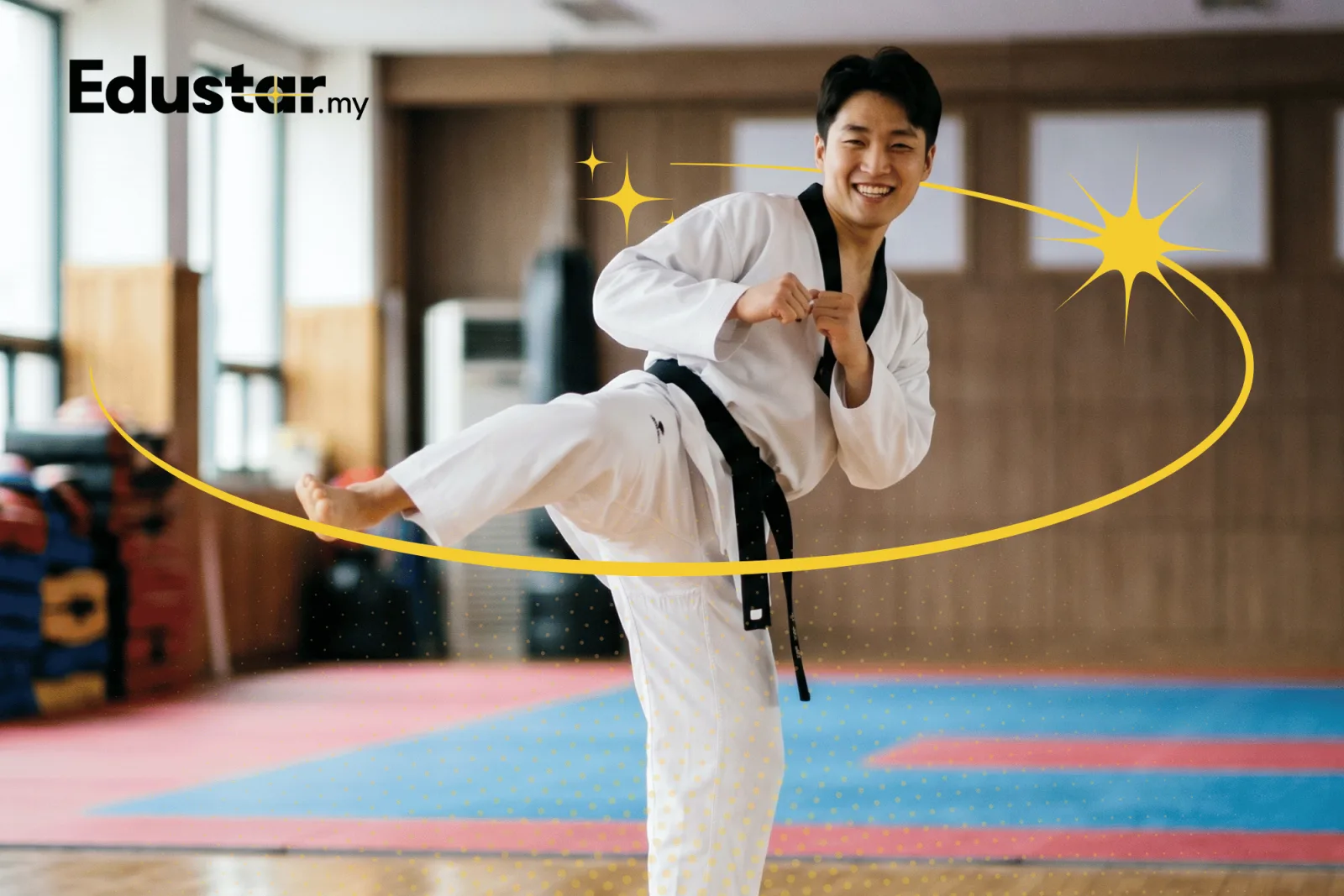
Taekwondo tuition in Malaysia runs as year-round coaching across two tracks held in parallel. The discipline-and-fitness track teaches kids and adults the Korean martial art's core mechanics: stances (apkubi, dwitkubi, juchum), the four foundational kicks (ap-chagi front, dollyo-chagi roundhouse, yop-chagi side, dwit-chagi back), one-step + two-step + three-step sparring (il-bo, i-bo, sam-bo daeryon), Poomsae (forms) memorisation, and breakfalling, building focus, respect (the tenets: courtesy, integrity, perseverance, self-control, indomitable spirit), and lifelong physical literacy. The competitive track follows the official ladder run by Persekutuan Taekwondo Malaysia (PTM), the sole national federation affiliated to World Taekwondo (WT) and certified under Kukkiwon (Korean HQ in Seoul): a 10-geup coloured-belt ladder (white 10th geup → yellow → green → blue → red → black tip / 1st keup), then 1st Dan (Il Dan, Kukkiwon-certified with a lifetime dan-bon number) through 9th Dan. The Poomsae syllabus across the WT lineage covers 17 official forms: 8 Taegeuk (Il-jang through Pal-jang) for the geup ladder, then 9 black-belt forms (Koryo for 1st Dan, then Keumgang, Taebaek, Pyongwon, Sipjin, Jitae, Cheonkwon, Hansu, culminating in Ilyeo at 9th Dan). The Kyorugi (sparring) track is Olympic-format since Sydney 2000, scored since London 2012 by the electronic Protector Scoring System (PSS, Daedo or KPNP e-Hogu chest + e-foot socks + head sensor) on the 1/2/3/4/5 point structure (1 punch trunk, 2 kick trunk, 3 turning kick trunk, 4 kick head, 5 turning kick head). The MY school pipeline runs through MSSM (Malaysia School Sports Council) at MSSD (district) → MSSN (state) → MSSM Kebangsaan (national) levels, then Sukma (Sukan Malaysia, biennial state-team Games, taekwondo medal sport since Sukma I 1986) and the Olympic-track via NSC Bukit Jalil + Akademi Taekwondo Negara, SEA Games, Asian Games and Olympic qualifiers under the Asian Taekwondo Union (ATU). The alternative ITF (International Taekwon-do Federation, founded 1966 by General Choi Hong Hi) lineage uses 24 Tul patterns and sine-wave movement: smaller MY presence, valid martial art, but not Olympic / Sukma / MSSM recognised. Edustar matches a PTM-affiliated sabum (instructor) who teaches the WT/Kukkiwon canon calibrated to the student's age, belt rank and target: recreational, MSSM medal, Sukma squad or Olympic Kyorugi.
- 01PTM (Persekutuan Taekwondo Malaysia) is the sole MY national federation under World Taekwondo (WT), issues grading recognition + organises national Poomsae and Kyorugi events; ITF MY clubs exist but are not Olympic/Sukma/MSSM-recognised
- 02Kukkiwon (Seoul, Korea) is the global Dan certification HQ, every WT-lineage 1st-9th Dan rank receives a lifetime Kukkiwon dan-bon (certification number) recognised worldwide
- 03Geup ladder: 10 coloured belts white (10th geup) → yellow (9-8) → green (7-6) → blue (5-4) → red (3-2) → red-with-black-tip (1st keup) → 1st Dan black belt; typical timeline 4-5 years to 1st Dan with 2-3 sessions per week
- 04Under-15 students who reach black-belt standard receive Poom (junior black belt, 1st-3rd Poom) under Kukkiwon rules, automatically convertible to Dan at age 15+
- 05Poomsae syllabus 17 forms: 8 Taegeuk (Il/I/Sam/Sa/O/Yuk/Chil/Pal-jang) on the geup ladder + 9 black-belt (Koryo at 1st Dan, then Keumgang, Taebaek, Pyongwon, Sipjin, Jitae, Cheonkwon, Hansu, Ilyeo at 9th Dan)
- 06Olympic Kyorugi PSS scoring (since London 2012): 1 pt punch trunk, 2 pt kick trunk, 3 pt turning kick trunk, 4 pt kick head, 5 pt turning kick head, head-target turning kicks are highest-reward strategy
- 07MSSM Taekwondo pathway: MSSD (district) → MSSN (state) → MSSM Kebangsaan (national); categories under-10, under-12, cadet 12-14, junior 15-17, senior 18+ with weight classes per category
- 08Sukma Games (biennial, National Sports Council) is the state-team pipeline, taekwondo medal sport since Sukma I 1986; SSBJ (Sekolah Sukan Bukit Jalil) + SSBP (Sekolah Sukan Bandar Penawar) intake recruits MSSM medallist juniors
- 09Olympic-track pathway: NSC Bukit Jalil + Akademi Taekwondo Negara → state junior squad → national squad → SEA Games + Asian Games + ATU regional qualifiers → Olympic qualification (MY benchmark: Tokyo 2020 Kyorugi qualifier)
- 10Edustar matches one PTM-affiliated sabum per student, calibrated to age + belt + target track; in-person across Klang Valley, Penang, Johor Bahru; online theory + Poomsae review nationwide via Zoom
Who Taekwondo tuition in Malaysia is for
We fit the sabum and the intensity to the student's actual starting point: discipline-and-fitness kids, the school-age MSSM competition track, teen and adult Olympic-Kyorugi aspirants, and adult re-starters returning to the art.
Kids 5-12 — discipline + fitness foundations
Primary-school first exposure to taekwondo as a focus + discipline + lifelong fitness vehicle. The child learns Korean terminology, bowing etiquette, the WT five tenets, foundational stances and the four core kicks (ap-chagi, dollyo-chagi, yop-chagi, dwit-chagi), breakfall safety, and the first Taegeuk forms (Il-jang, I-jang). Suitable for kids from SK, SJK(C), SMK, SJK(T), homeschool and private backgrounds. Goal: enjoy the art, build the habit, grade smoothly from white through yellow and green belt, optionally enter MSSD under-10 or under-12 categories at Year 4-5 if interested in competition.
- Child is high-energy and needs a structured outlet for focus + discipline that team sports do not provide
- Parent wants the cognitive + behavioural benefits but is wary of dojang group classes that move too fast for a young beginner
- Group class taught in Bahasa or English-only when the family prefers a sabum who can use both alongside Korean terminology
- Child interested in competition but the local dojang only enters tournaments occasionally
School-age MSSM track (Year 4-6 + Form 1-5 competition students)
Already trains regularly, holds at least a green belt (7th geup) and has competed at MSSD district level or wants to. Coaching focus: full Taegeuk repertoire (Sam-jang through Pal-jang), Kyorugi tactics calibrated to PSS scoring (1/2/3/4/5 point structure), weight management for cadet (12-14) or junior (15-17) categories, Poomsae presentation discipline, mental routine for tournament day. Goal: MSSD medal → MSSN qualification → MSSM Kebangsaan medal contention → SSBJ Sekolah Sukan Bukit Jalil or SSBP Sekolah Sukan Bandar Penawar shortlist if exceptional.
- Stuck at MSSD bronze / no-medal level, wins early rounds but loses to better-prepared opponents in semis
- Kyorugi point-trade is wrong way, racks up 1-point punches but never lands the 4 or 5 point head kick
- Weight category sits awkwardly, either cutting too aggressively for a lower class or competing up a class against bigger juniors
- No coherent Poomsae progression, knows the form but not the judge-scoring criteria (accuracy 4.0 + presentation 6.0)
Teen / adult Olympic-Kyorugi track
Holds black belt (1st Dan or higher), competes seriously in senior 18+ weight categories at state and national level, or is a strong junior tracking toward SEA Games + ATU + Asian Games + Olympic qualification. Coaching focus: full PSS-format sparring strategy, opponent video study, high-percentage kick selection (front-leg dollyo-chagi as the workhorse scoring kick), turning-kick installation for 5-point opportunities, periodisation for tournament cycles, NSC Bukit Jalil + Akademi Taekwondo Negara selection process awareness.
- PSS scoring strategy is unclear, feels like sparring is random rather than point-engineered
- Front-leg dollyo-chagi too slow against quicker opponents; turning kicks land 1 in 20
- Conditioning plateau: sparring stamina drops in round 3, last 30 seconds of close bouts decide losses
- Sukma / state-squad selection window unclear; not sure how to translate club results into selection consideration
Adult re-starter / recreational improver (re-entering as 1st-3rd Dan or starting fresh)
Either returning to taekwondo after a 5-15 year break (often as a teen black-belt re-entering as an adult) or starting fresh as an adult interested in discipline, fitness and martial-art credential without competitive pressure. Coaching focus: dust-off basics with realistic adult-body conditioning, Poomsae refresh through Taegeuk Il-jang to Pal-jang plus Koryo if 1st Dan, joint-friendly drilling, Kukkiwon Dan re-certification + onward grading (2nd / 3rd Dan), optional demonstration team or recreational Poomsae competition entry. Goal: rebuild the practice as a lifelong discipline.
- Body remembers the kicks but at 1/3 the speed; not sure how hard to push without injury
- Adult dojang classes mostly run for children, feels out of place at a 7pm kids class
- Old Kukkiwon dan-bon paperwork lost, unclear how to reactivate or apply for next Dan
- Wants a structured 3-6 month return-to-form plan that goes beyond "come back to class"
What taekwondo coaching covers
Three modules across the WT/Kukkiwon journey: white-yellow geup foundations (stances + four kicks + breakfall), green-blue Poomsae and step-sparring (Taegeuk forms + il-bo / i-bo / sam-bo daeryon), red-black Koryo and free sparring (PSS-format Kyorugi + Sukma/MSSM competition track).
White-Yellow geup — stances, four foundational kicks, breakfall (Age 5-10 or adult beginner)
Build the taekwondo habit through stance discipline, the four core kicks, breakfall (nakbop) safety and the first two Taegeuk forms. Drills the five WT tenets (courtesy, integrity, perseverance, self-control, indomitable spirit) alongside Korean terminology so the student grades smoothly through the early belt cycle.
Korean basic terminology (charyeot attention, kyeongnye bow, junbi ready, sijak begin, geuman stop); fundamental stances (apkubi front stance, dwitkubi back stance, juchum-seogi horse-riding stance, naranhi-seogi parallel ready, ap-seogi walking stance); the four foundational kicks (ap-chagi front snap kick, dollyo-chagi roundhouse, yop-chagi side kick, dwit-chagi back kick) drilled both target-pad and air; basic hand techniques (jireugi punch, makki blocks, arae / momtong / olgul down/middle/high); breakfall practice (front, side, back nakbop) on safety mats; first Poomsae, Taegeuk Il-jang for yellow belt + Taegeuk I-jang for yellow stripe; first one-step sparring (il-bo daeryon): bow, set position, single attack, single defence, return; five WT tenets memorised in English + Korean; grading prep for white-belt 10th geup through yellow-stripe (9th geup) under PTM-affiliated club; SEGAK-aligned conditioning for school-age students (push-ups, sit-ups, sit-and-reach, 2.4 km run benchmarks).
Green-Blue Poomsae + step-sparring + light contact (Year 4-6 + Form 1-3, MSSM primary + lower-secondary track)
Build the full coloured-belt curriculum and entry-level competition stamina for the MSSM (MSSD → MSSN → MSSM Kebangsaan) school pathway. Coaches drill the middle Taegeuk forms, jumping + turning kicks, two-step + three-step sparring and light-contact Kyorugi to introduce the PSS scoring logic before full-contact full-PSS sparring.
Intermediate Taegeuk forms (Sam-jang green belt, Sa-jang green stripe, O-jang blue belt, Yuk-jang blue stripe), memorisation + line-by-line technical breakdown + power generation through hip rotation; advanced kicks introduced (twio ap-chagi jumping front kick, twio dollyo-chagi jumping roundhouse, naeryo-chagi axe / downward kick, mom-dollyo-chagi spinning back kick, dwi-huryo-chagi spinning hook kick); two-step (i-bo) and three-step (sam-bo) daeryon, formal step-sparring with multi-strike sequences; introduction to free-style sparring (jayu daeryon) with light contact + foam chest guards before full PSS gear; Poomsae competition format under PTM, judge scoring criteria (accuracy 4.0 + presentation 6.0 max), Recognition events for primary + secondary categories; Kyorugi scoring rules introduction (1/2/3/4/5 point PSS structure, punch trunk / kick trunk / turning kick trunk / kick head / turning kick head); weight cutting absent at this stage: focus on technique, not making weight; MSSD school-level taekwondo entry (most state JPN run district championships annually for under-10, under-12 categories); SEGAK fitness retest cycle; grading prep through green belt (6th geup), green stripe (5th geup), blue belt (4th geup), blue stripe (3rd geup) under PTM-affiliated club + initial MSSM uniform compliance (white dobok with V-neck collar coloured per rank).
Red-Black — Koryo and onward, free sparring with full PSS, Sukma/MSSM competition track (Form 4-5 + adult competitive)
Push from coloured-belt regular to 1st Dan Il Dan certification and meaningful MSSM Kebangsaan + Sukma medal contention. The coach drills the final Taegeuk forms, prepares the Kukkiwon-syllabus 1st Dan poomsae Koryo, runs full PSS-gear sparring at Olympic time controls, and walks the student through the Kukkiwon dan-bon application + Sukma/SEA Games selection windows.
Final Taegeuk forms (Chil-jang red belt 2nd geup, Pal-jang red stripe 1st keup), examination-grade precision required; 1st Dan poomsae Koryo (40 movements, signature kicks scissor-block to high section kick), full memorisation + power + presentation; Kukkiwon Dan grading test format under PTM-sanctioned panel: basics demonstration, poomsae, kyorugi, breaking (kyokpa, usually pine boards or rebreakable plastic); full PSS sparring at Olympic format, 3 × 2-min rounds (cadet shorter), 1-minute rest, PSS e-Hogu chest + e-foot socks + head sensor, electronic scoring on Daedo or KPNP; high-percentage Kyorugi techniques against PSS, front-leg dollyo-chagi (trunk 2 pt + safe), naeryo-chagi to head (4 pt), turning back kick / spinning hook kick to head (5 pt highest reward but lowest connection rate); weight management discipline for MSSM cadet/junior/senior weight classes, gradual cut, hydration, not crash dieting; tournament-day routine, weigh-in, warm-up, between-bout recovery, video review; MSSM Kebangsaan medal pathway → SSBJ (Sekolah Sukan Bukit Jalil) or SSBP (Sekolah Sukan Bandar Penawar) intake for combined sport-academic training; Sukma state-team selection cycle (biennial); NSC Bukit Jalil + Akademi Taekwondo Negara national squad selection; ATU (Asian Taekwondo Union) ranking events, ATP Approved Tournament Programme participation; SEA Games + Asian Games + Olympic qualifying pathway (MY benchmark: Tokyo 2020 Kyorugi qualifier); demonstration team option (breaking + acrobatic poomsae, popular K-wave style) for non-Kyorugi competitive students; 2nd Dan (Keumgang) onward progression after minimum 2-year wait per Kukkiwon rules.
From first call to first taekwondo coaching session
How Taekwondo training with Edustar begins: a diagnostic first, belt-target sequencing second, competition and Dan grading third.
- 1
Free needs assessment (Day 0)
Share the student's age, current belt rank (if any, white through black), lineage (WT/Kukkiwon vs ITF preference), training history, target track (recreational + fitness / MSSM school medal / Sukma squad / Olympic Kyorugi / adult Dan ladder), and available training time per week. We give an honest read on what the timeframe allows, 4-5 years to 1st Dan is the standard ladder; faster paths exist only at full-time training intensity.
~15 min - 2
Diagnostic, basics assessment + Poomsae demo
First in-person session is a diagnostic: sabum runs the student through stance check (apkubi, dwitkubi, juchum), the four foundational kicks for power + form, current Poomsae demo (Il-jang for white belt → Koryo for 1st Dan), breakfall safety, and a light sparring round if appropriate to gauge timing. The aim is to identify the 3-4 recurring weaknesses (low chamber on kicks, hip rotation, balance, sparring distance management) that the remaining lessons will work on.
Before lesson 1 - 3
Sabum matching (level + temperament + lineage)
We match a PTM-affiliated sabum calibrated to the student's belt level + age + target track. Black-belt Dan-holder instructors required for any black-belt or pre-Dan student; coloured-belt instructors fine for beginner kids. We match temperament too: patient, slower-tempo sabum for young beginners and adult re-starters; tournament-focused sabum for MSSM and Olympic-track students. In-person across Klang Valley, Penang, Johor Bahru where PTM dojang networks are dense; online theory + Poomsae review via Zoom for students outside major centres.
1-3 days - 4
First lesson, basics anchor + next-belt roadmap
Sabum anchors to one belt-grading target so the next 3-4 months has a clear direction. For beginners: white-to-yellow geup foundations (stances + ap-chagi + Taegeuk Il-jang). For green-blue students: intermediate kicks (jumping + spinning) + Sam-jang to O-jang. For red-belt students: pre-Dan exam prep, Pal-jang precision, Koryo intro, full PSS sparring. For adult re-starters: joint-friendly basics rebuild + Dan recertification paperwork review.
Lesson 1 - 5
Weekly drilling, basics + Poomsae + sparring + conditioning
Weekly 1-to-1 sessions, typically 1-1.5 hours. Four-part split: (a) warm-up + basics, stance, line drilling the four core kicks; (b) Poomsae work at current belt's form + next belt's preview, frame-by-frame correction; (c) sparring / step-sparring depending on belt (il-bo / i-bo / sam-bo daeryon for under-blue, light contact for blue-red, full PSS gear from red onward); (d) conditioning, sport-specific cardio, flexibility for high kicks, SEGAK-aligned strength benchmarks for school-age students. Between sessions: solo drilling at home + optional PTM-affiliated dojang group class for sparring partners.
Ongoing, weekly - 6
Grading + competition prep, MSSM / Sukma / Dan testing cycles
From 6-12 weeks before a target grading or tournament, focus shifts to event-specific prep: current Poomsae syllabus polish for grading, opponent video study + tactical PSS-scoring plan for MSSM/Sukma Kyorugi, weight management discipline (gradual cut, hydration, no crash dieting) for weight-class events. Pre-event briefing covers tournament-day routine: weigh-in timing, warm-up, between-bout recovery, staying composed after a loss. For Dan testing: full mock test of basics + Poomsae + Kyorugi + breaking (kyokpa) under PTM panel format.
Final 6-12 weeks pre-event - 7
Post-event review + next-cycle planning
Within a week of the grading or tournament, sabum reviews the student's performance: what scored, what didn't, what to drill next. Updates the multi-year plan: next belt grading in 3-4 months, next MSSD entry, MSSN qualification cycle, MSSM Kebangsaan medal pathway, Sukma state-squad selection window, Dan testing schedule. For Olympic-track students, NSC Bukit Jalil + Akademi Taekwondo Negara selection windows tracked annually. Coaches stay available across grading cycles for continuity.
1 week post-event
Things parents ask us first
The PTM → MSSM → Sukma → Olympic Kyorugi pipeline in Malaysia
Persekutuan Taekwondo Malaysia (PTM) is the sole national federation under World Taekwondo (WT) and Kukkiwon (Seoul): the only lineage recognised for Olympic, Sukma and MSSM competition in MY. The realistic competitive pathway: register with a PTM-affiliated dojang → grade through the 10-geup coloured belt ladder under PTM-sanctioned panels → enter the MSSM school pipeline (MSSD district → MSSN state → MSSM Kebangsaan national) if school-age → top medallists shortlisted for SSBJ Sekolah Sukan Bukit Jalil or SSBP Sekolah Sukan Bandar Penawar intake → state Sukma squad selection (biennial Games) → national NSC Bukit Jalil + Akademi Taekwondo Negara squad → SEA Games, Asian Games, ATU ranking events → Olympic qualifier (MY benchmark: Tokyo 2020). For adults, the same PTM ladder applies: there is no separate adult tournament structure, only senior 18+ weight categories at state and national open events.
WT/Kukkiwon vs ITF, pick lineage before committing 4-5 years to black belt
Two world taekwondo lineages exist. WT (World Taekwondo, formerly WTF) + Kukkiwon (Seoul HQ) is the Olympic + Sukma + MSSM + SEA Games recognised body: uses 17 official Poomsae forms (8 Taegeuk + 9 black-belt), Kyorugi with electronic PSS, dan-bon certification recognised worldwide. ITF (International Taekwon-do Federation, founded 1966 by General Choi Hong Hi) uses 24 Tul patterns with the distinctive sine-wave movement, different sparring rules (point-stop continuous, no PSS), and is not Olympic-recognised. ITF MY presence is small but real and is a valid martial art. The decision matters because the syllabi do not transfer: a WT 1st Dan does not automatically convert to ITF 1st Dan or vice versa, and the typical 4-5 year geup-to-Dan investment is lineage-specific. For MY parents whose child wants MSSM medal or Olympic aspiration: WT/Kukkiwon only. For pure martial-art interest with no competitive ambition: either is acceptable. Edustar matches WT/Kukkiwon-track coaches by default; flag if ITF preferred during consultation.
Poomsae vs Kyorugi vs Demonstration: three competitive tracks, pick by temperament
WT taekwondo competition splits into three tracks. Poomsae (forms) is precision + memory + presentation, judges score accuracy 4.0 + presentation 6.0 for a maximum 10.0 per form. Suits kids 6-10 starting out, students who prefer non-contact, older juniors and adults of any age. Kyorugi (sparring) is full-contact Olympic format with PSS electronic scoring (1/2/3/4/5 points), 3 × 2-min rounds, weight categories. Demands aggressive temperament, weight discipline, sparring partners, full gear. Demonstration is breaking (kyokpa, pine boards, rebreakable plastic, multi-board jumping breaks) plus choreographed acrobatic poomsae sequences, the K-wave style popularised by Kukkiwon Demonstration Team. A student can compete in more than one track but coaches typically calibrate the dominant track by belt blue (4th geup): Poomsae focus, Kyorugi focus, or balanced. Edustar matches sabum accordingly.
Geup to Dan: the realistic 4-5 year ladder, and why "Poom" exists for under-15s
Honest timeline from white belt to 1st Dan (Il Dan) Kukkiwon-certified black belt under WT/PTM rules: 4-5 years of consistent training at 2-3 sessions per week, faster (~3 years) for athletic teens with daily training, slower (~6-7 years) for casual recreational students. The 10-geup ladder: white (10th geup) → yellow (9th) → yellow stripe (8th) → green (7th) → green stripe (6th) → blue (5th) → blue stripe (4th) → red (3rd) → red stripe (2nd) → red with black tip / 1st keup (1st geup). Grading interval typically 3-4 months between coloured belts, 6 months minimum at red stripe before 1st Dan testing. Kukkiwon rules require minimum age 15 for 1st Dan certification: students who reach black-belt standard before 15 are awarded Poom (junior black belt, 1st-3rd Poom, white-and-black half-belt) which converts automatically to Il Dan at age 15. Between Dan ranks Kukkiwon mandates minimum-wait years: 2 years for 1st→2nd Dan, 3 years 2nd→3rd, 4 years 3rd→4th, and so on (n years from nth to (n+1)th Dan). Anyone advertising "black belt in 12 months" outside this ladder is not following PTM/Kukkiwon rules.
PSS scoring rules reshape sparring strategy, head turning kicks are 5-point gold
Since London 2012, Olympic and WT-sanctioned Kyorugi has been scored by the electronic Protector Scoring System (PSS, Daedo, KPNP, or equivalent e-Hogu chest sensor + e-foot socks + head sensor). The 1/2/3/4/5 point structure: 1 point for a clean punch to the trunk, 2 points for a kick to the trunk, 3 points for a turning kick to the trunk, 4 points for a kick to the head, 5 points for a turning kick to the head. Knowing the maths reshapes strategy: turning head kicks (dwi-huryo-chagi spinning hook, mom-dollyo dadi spinning back kick to head, naeryo-chagi axe to head) are highest reward but lowest connection rate; front-leg fast dollyo-chagi to the trunk is the high-percentage scoring kick most matches are decided on. Cadet (12-14) and junior (15-17) categories run 3 × 1.5-min rounds; senior (18+) runs 3 × 2-min rounds with 1-min rest. Edustar coaches drill the PSS-calibrated strategy from blue belt upward: earlier than that, the focus stays on technique foundations, not point hunting.
Online taekwondo is theory + Poomsae review only, sparring needs a physical partner
Some skills transfer to online coaching effectively. Poomsae review via Zoom video works well: coach watches the student perform Il-jang through Pal-jang and the black-belt Koryo, gives correction frame-by-frame, drills Korean terminology and grading-test format knowledge. Theory blocks (PSS scoring rules, tournament regulations, weight category structure, MSSM/Sukma calendar, Kukkiwon Dan application paperwork) transfer fully. What does not transfer online: contact sparring, target-pad striking, partner-drill timing, breakfall safety supervision, full PSS-gear Kyorugi simulation. Edustar's default sport coaching is in-person across Klang Valley, Penang and Johor Bahru, areas with dense PTM-affiliated dojang networks. Online is the layer for students in East Malaysia or smaller towns where physical sabum access is limited, paired with periodic in-person intensives or a local club affiliation for partner work.
What Taekwondo tuition with Edustar covers
Honest scope: no guaranteed medals or grading passes, just structured PTM / Kukkiwon / MSSM / Sukma-aligned coaching.
Age 5 – adult
Levels supported (kids beginner to senior Dan ladder)
WT / Kukkiwon
Lineage covered (PTM-affiliated, Kukkiwon dan-bon recognised worldwide)
MSSM + Sukma + Olympic
Competition tracks (MSSD → MSSN → MSSM Kebangsaan + Sukma + SEA Games + ATU + Olympic qualifying)
Nationwide
In-person (Klang Valley / Penang / Johor) + online theory + Poomsae review
Edustar 1-to-1 sabum vs local dojang group class vs sports centre programme vs self-study
Four routes through Malaysian taekwondo training: most serious students combine 1-to-1 sabum coaching with PTM-affiliated club grading, but each route has different strengths and costs.
Edustar 1-to-1 sabum
Format
Weekly 1-to-1 with a PTM-affiliated sabum; curriculum + grading prep + competition strategy customised per student
Diagnostic depth (catches recurring mistakes)
Sabum reviews every kick, stance and Poomsae rep; individual correction within minutes
Poomsae coaching depth (frame-by-frame correction)
Frame-by-frame video correction weekly; Koryo and onward Black-belt forms prepared individually
Kyorugi sparring access (full PSS gear)
Sabum coordinates partner drills + spar sessions at affiliated dojang; PSS simulation in competition lead-up
Grading panel access (10-geup + Dan)
Coach coordinates PTM-sanctioned grading at affiliated dojang on schedule
Per-hour / monthly cost (MYR, indicative)
RM 80-200 per hour 1-to-1 (Dan-holder sabum at upper end; coloured-belt instructor at entry range)
Match to MY pathway (PTM / MSSM / Sukma)
Calibrated to MSSM age + weight category, Sukma cycle and Kukkiwon dan-bon application
Best for
Students serious about Dan grading + MSSM medal + Sukma squad + Olympic Kyorugi pipeline; or adults with limited fixed-schedule availability
Local dojang group class (PTM affiliate)
Format
Weekly group class of 10-30 mixed belts at PTM-affiliated dojang; structured syllabus + grading panels in-house
Diagnostic depth (catches recurring mistakes)
Limited per student; sabum runs the room, corrections cycle through 30+ belts
Poomsae coaching depth (frame-by-frame correction)
Group drilling of class-level form; individual breakdown only at grading prep window
Kyorugi sparring access (full PSS gear)
Strong, class includes partner sparring; full PSS gear typically available for senior belts
Grading panel access (10-geup + Dan)
In-house grading panels every 3-4 months for coloured belts; Dan testing under PTM-sanctioned regional panel
Per-hour / monthly cost (MYR, indicative)
RM 120-300 per month (typically 2-3 group sessions per week + grading + tournament entry separate)
Match to MY pathway (PTM / MSSM / Sukma)
Strong, PTM affiliation is the on-ramp; first MSSD entry handled through the dojang school programme
Best for
Default route for most MY juniors: affordable, structured, social, full grading access
Sports centre programme
Format
Term-based group programme at commercial sports centre or international school; structured but mid-volume
Diagnostic depth (catches recurring mistakes)
Moderate; instructor-to-student ratio better than dojang but no individual long-term plan
Poomsae coaching depth (frame-by-frame correction)
Class-level form drilled; individual correction limited
Kyorugi sparring access (full PSS gear)
Variable; some programmes include light sparring, others Poomsae-only
Grading panel access (10-geup + Dan)
Grading via affiliated PTM club partnership; varies by centre
Per-hour / monthly cost (MYR, indicative)
RM 150-400 per month (term-based, includes uniform + basic gear in some packages)
Match to MY pathway (PTM / MSSM / Sukma)
Moderate; competition entry depends on the centre's PTM tie-ups
Best for
Convenient if attached to an international school or club where the student already trains
Self-study (YouTube + solo drilling)
Format
Self-paced YouTube + Kukkiwon syllabus videos + solo basics drilling; no live sabum
Diagnostic depth (catches recurring mistakes)
Zero, a student only spots what they can already recognise
Poomsae coaching depth (frame-by-frame correction)
Possible via Kukkiwon Demonstration Team YouTube channel but with no correction loop
Kyorugi sparring access (full PSS gear)
Impossible, sparring requires a willing trained partner + PSS gear; cannot be self-studied
Grading panel access (10-geup + Dan)
Not possible, Kukkiwon Dan requires PTM-sanctioned panel + dan-bon application paperwork
Per-hour / monthly cost (MYR, indicative)
Free YouTube + Kukkiwon channel; only equipment cost (dobok RM 80-200)
Match to MY pathway (PTM / MSSM / Sukma)
None: no PTM affiliation, no grading recognition, no MSSM eligibility
Best for
Equipment familiarity + Poomsae visualisation only; cannot replace dojang training
Frequently Asked Questions
Common questions from Malaysian taekwondo parents, students and adult practitioners.
Start Taekwondo tuition with Edustar
Free needs assessment + PTM-affiliated sabum matched within 1-3 days. WT/Kukkiwon lineage, MSSM school + Sukma + Olympic Kyorugi pathway, Dan ladder support, nationwide in-person or online theory.
- Free needs assessment + basics + Poomsae diagnostic
- PTM-affiliated sabum matched by belt level + age + target track
- Sequenced curriculum: 10-geup ladder + Taegeuk Poomsae + PSS Kyorugi + Dan grading prep
- MSSM / Sukma / SEA Games / Olympic Kyorugi competition prep
- Home or online theory, nationwide
Edustar — Malaysian private tuition, KPM-aligned tutors.