Table Tennis Tuition in Malaysia
Table tennis at Edustar puts a coach directly opposite one player, remaking the game stroke by stroke: the bat angle, the spin on a serve, the third-ball attack. Two routes travel side by side. One is a fitness-and-fun line for children and adults who simply want clean, honest rallies. The other is the medal line drawn onto the Persatuan Tenis Meja Malaysia (PTM, ITTF code MAS): PTM-certified club coaching, the MSSM school championships that rise from MSSD to MSSN to MSSM Kebangsaan, then state-squad selection aimed at the Akademi Tenis Meja Negara at Bukit Jalil and the WTT benchmark.
What is Table Tennis Tuition?
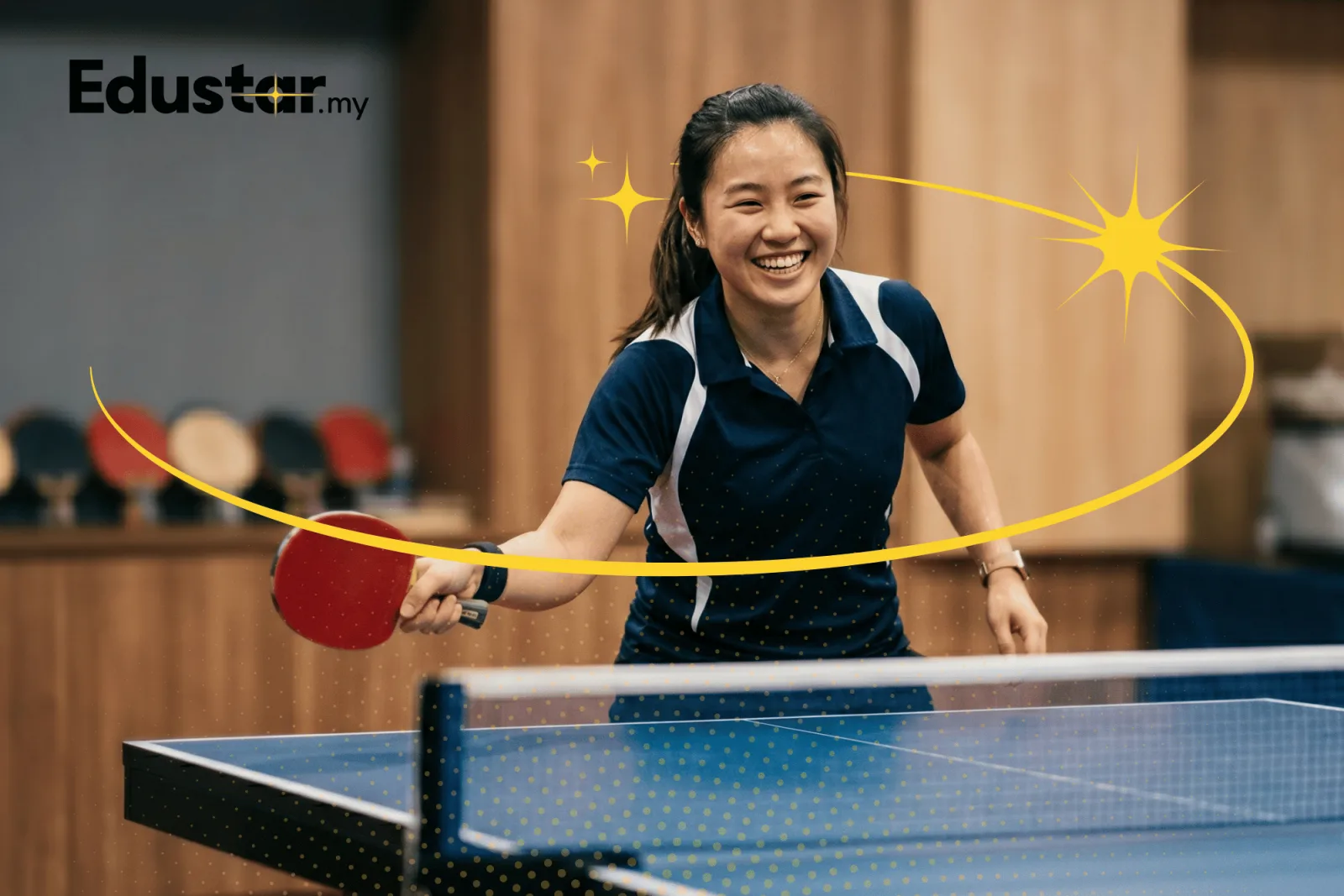
Table tennis coaching in Malaysia is year-round work at the table, and a good coach keeps two parallel tracks in view at all times. The first is the fitness-and-foundation track, which carries children (commonly from age 5-6) and adult beginners through the universal canon every player learns before anything else: the grip decision (shake-hand for matched forehand-and-backhand mechanics, or pen-hold including the modern Reverse Pen-hold Backhand / RPB), an athletic ready-stance (knees flexed, weight over the balls of the feet, bat carried at table height), the four first-year strokes (forehand drive, backhand drive, forehand push, backhand push), and the short serve dressed up with sidespin and topspin disguises. The second is the competitive track, which follows the official Persatuan Tenis Meja Malaysia (PTM / Malaysian Table Tennis Association, founded 1949, ITTF country code MAS) route: club coaching from PTM-certified instructors schooled through the ITTF Coach Education Programme (Level 1 Foundation, Level 2 Advanced, Level 3 High Performance, along with the ITTF Para-Table-Tennis and Youth modules), then the MSSM (Malaysia School Sports Council) school championships rising from the district round (MSSD) up through state (MSSN) and finally national level (MSSM Kebangsaan), then Sukma (Sukan Malaysia, the biennial inter-state games) together with the PTM state-association elite junior squads. At the very top waits a seat in the PTM national squad that trains at the Akademi Tenis Meja Negara inside the Bukit Jalil National Sports Complex, with NACMP support holding SPM / STPM study and national training in balance. Overseas, the yardstick is the WTT (World Table Tennis) ladder: WTT Youth Contender, WTT Feeder, WTT Contender, WTT Star Contender, WTT Smash, with the SEA Games table tennis circuit standing as the realistic mid-career target for dedicated MY juniors. The ITTF rules in force since 2014 set the frame: a 40+ mm poly ball, sets played to 11 points, best-of-5 or best-of-7 matches, the serve passing every 2 points, the service let, and the expedite rule that triggers after 10 minutes of a set. Every Edustar student is paired with a coach tuned precisely to where they currently sit on this route.
- 01PTM (Persatuan Tenis Meja Malaysia, founded 1949, ITTF country code MAS) is the country's only national federation. It administers the PTM-aligned ITTF Coach Education Programme (Level 1 / 2 / 3) and puts out the national squads based at the Akademi Tenis Meja Negara at Bukit Jalil
- 02MSSM Tenis Meja is the schools competition. A player first wins through at district level (MSSD / Daerah), moves up to state (MSSN / Negeri), and the ones left standing meet at MSSM Kebangsaan. It runs every year for primary (Year 4-6) and secondary (Form 1-5), across singles, doubles and team-of-three
- 03How the table's rules work: sets run to 11 points, matches are best-of-5 or best-of-7, the serve is handed over every 2 points, the ball is a 40+ mm plastic sphere (it took over from the old 38 mm celluloid in 2014), the service let stands, and the expedite rule switches on once a set passes 10 minutes with neither player at 9
- 04The grip is a one-time fork in the road: shake-hand (favoured by most MY juniors and standard across Europe and Asia, symmetric across forehand and backhand) or pen-hold (a historically larger forehand and a thinner backhand, until the modern Reverse Pen-hold Backhand / RPB closed the gap). A coach settles it early and does not revisit it
- 05Rubber comes off the ITTF LARC list (Authorised Racket Coverings): inverted for offence and spin (today's default), short pips for flat all-round hitting, long pips for defensive chop and disruption, anti-spin for pure defence. Every side is capped at 4.0 mm of rubber-plus-sponge
- 06Sukma (Sukan Malaysia), the biennial inter-state games, sits between MSSM Kebangsaan and senior national reckoning. State under-15 / 17 / 19 squads feed it, and a Sukma medal regularly draws a PTM trial invitation
- 07SEA Games table tennis is the realistic mid-career target abroad, and Malaysia carries a genuine record here. Beh Lee Wei (former MAS No. 1 in women's singles, a SEA Games medallist across several editions), Ho Ying (women's singles) and Choong Javen (men's singles) mark the line, with today's players followed through PTM
- 08WTT (World Table Tennis) has graded the world circuit since 2021: WTT Smash sits at the top, then Star Contender, Contender, Feeder and Youth Contender, the structure that replaced the old ITTF World Tour. MAS players enter on PTM nomination
- 09KBS (Kementerian Belia & Sukan), working with the National Sports Council (MSN) based at Bukit Jalil, runs the NACMP initiative (National Athletes' Career and Education Programme), letting an elite student-athlete carry SPM / STPM alongside national training
- 10Edustar sets one coach with one student, matched to that student's stage on the route. Sessions run table-side across Klang Valley, Penang and Johor, and online whenever the work is tactical or built on video
Who Table Tennis tuition in Malaysia is for
For table tennis the coach and the tempo follow where a player already stands: kids aged 5-10 building foundations, MSSM hopefuls still in school, adults who play for recreation, and competitive aspirants on the PTM pathway.
Kids 5-10 — beginner foundations
This is where a child first meets table tennis as a genuine sport. The child can already hold a bat and keep a short rally going, so the work now is fixing the grip (shake-hand or pen-hold), grooving an athletic ready-stance, learning the four first-year strokes (forehand drive, backhand drive, forehand push, backhand push) and a first short serve, and building the habit of watching the bounce and the spin. The door stays open to children from homeschool, private, national, and Chinese- or Tamil-medium backgrounds, and it often runs alongside school-team practice. The goal is plain: enjoy the game, sharpen hand-eye coordination and reaction speed, and step into MSSD district play around Year 4-5 if the child wants it.
- The child loves rallying yet holds the paddle wrong, and a faulty grip will cap the technique ceiling
- A school TT team is there, though mixed-ability and without a structured grip or stance curriculum
- A parent bought a heavy senior-spec racket too soon, so the child cannot swing through fully
- The Saturday group class is fun, yet the child stalls on the same drills week after week with no individual progression
School-age MSSM aspirants (Form 1-3)
This player is already competing in school events and at MSSD, sometimes reaching MSSN state level, with a school-team teacher-coach yet nobody watching one-to-one. What they need is a diagnostic eye to break the plateau. Coaching turns to a matched backhand drive (or the RPB for pen-holders), reading serve spin cleanly, building the serve-and-third-ball rally, a first topspin loop, doubles court-half discipline, and match-tempo fitness at the school format (best-of-5 to 11, serve every 2 points). The aim is an MSSM Kebangsaan medal within reach and a state-association under-15 / 17 squad place.
- Stuck at MSSN round-of-16, winning the easy matches but coming undone against fitter opponents by the fifth game
- Cannot read the opponent's serve spin, dropping 3-4 points a set on serve-return alone
- A strong forehand drive sits next to an unreliable backhand, and opponents keep working the backhand corner
- Knows MSSM Kebangsaan and Sukma exist, but has no clear way up from today's MSSN level
Adults playing for recreation (working professionals and parents)
Plays somewhere between one and three sessions a week at a township club or on the office gym table, usually squeezed in after work or during weekend mornings. Some come back to the bat after stopping at SPM, others pick it up fresh as adults chasing fitness and quick reactions. A few chase sharper technique for the club social ladder; others just want to stay in the game comfortably at 40, 50 and beyond. Coaching here corrects the grip (most adult-onset players carry a self-taught hybrid), retrains the stance, teaches a first proper forehand loop, opens up basic spin-reading, and tidies the doubles rotation. Few sports fit adult fitness so well: table tennis stays gentle on the body, quick for the mind, and playable deep into senior age.
- Trains twice a week but has been flat for years, with bad grip and stance habits baked in since teenage play
- Cannot read sidespin serves, so social-ladder opponents who serve tricky yet rally poorly still win
- Never learned the forehand loop, so the whole game is flat-hitting and runs into a power ceiling
- The doubles partner plays with no rotation logic, and results swing match to match
Competitive aspirants on the PTM pathway (Form 4-5 + young adult)
A strong MSSN / MSSM Kebangsaan junior pushing toward a Sukma state squad and the PTM state-association elite junior line, already a fixture in PTM-affiliated club tournaments and state-circuit events. Coaching now digs into tactics: serve-and-attack templates, the call between committing the third ball and the fifth, the counter-loop, and hunting the opponent's backhand corner. It leans on opponent video study pulled from WTT broadcasts, SEA Games TT and MSSM Kebangsaan finals, on physical conditioning built for senior demand, and on a settled mental routine (the between-set reset, staying off tilt after a dropped set, a plan for the expedite rule). Where the talent earns it, the road points toward an Akademi Tenis Meja Negara trial. This player already understands the deal: the PTM elite track asks for years of unbroken work, never a sprint.
- Stalled at MSSN gold-medal standard, in command of the strokes yet not converting that technical edge into steady results
- No dependable read on which two or three tactical patterns are worth deep preparation this season
- Tournament choices are made ad-hoc, entering events that do nothing for the PTM state-association radar
- Juggling an SPM / STPM academic load against daily training, and needing NACMP-aware coaching
What table tennis coaching covers
Coaching moves through three modules on the table tennis journey. Foundations builds the grip, stance, serve and forehand drive for ages 5-10 as well as a first-time adult. Intermediate adds the backhand, spin reading, the 5-stroke rally and MSSD entry on the Form 1-3 MSSM track. Advanced sharpens footwork, tactics, and the run at MSSM Kebangsaan plus PTM state-squad selection aimed at Form 4-5 and elite juniors.
Foundations — grip, stance, serve, forehand drive (age 5-10 + first-time adult)
Put the four pillars in place that every later rally leans on, well before any tactic gets taught. The grip is locked in (shake-hand or pen-hold), the ready-stance turns into a reflex, the first short serve learns to bite, and the forehand drive becomes the spine of the attacking game. It is open to primary pupils (Year 1-6) and to adults starting from scratch at any age. The module runs about 12 weeks.
Grip choice: shake-hand (forehand and backhand run off the same grip with a small thumb shift, the European and most-MY-junior standard) against pen-hold (the penholder grip, historically a stronger forehand and a weaker backhand, with the modern Reverse Pen-hold Backhand / RPB variant now closing that gap, though the choice is best committed early). Ready-stance: knees flexed, weight over the balls of the feet, paddle at table level, the body squared to the table. Forehand drive technique: a closed paddle face, contact at the peak of the bounce, full body rotation running from the hips through the shoulders, and a follow-through across the body. First serve: a short pendulum serve carrying sidespin (one bounce on the opponent's side, no second bounce escaping long) plus a short topspin serve. Basic table geometry: short ball against long ball, the corners against the wide angles, and the middle elbow zone as the natural target. Bat selection for a first frame: an all-round blade, inverted rubber on both sides, sponge 1.8-2.0 mm for juniors, a 4.0 mm cap under the ITTF LARC rule. Ball type: 40+ mm plastic (the ITTF post-2014 standard). A first route into MSSD-level school table tennis for school-age kids.
Intermediate — backhand, spin reading, 5-stroke rally, MSSD entry (Form 1-3 MSSM track)
Add the second wing and learn to read what the ball is doing. This module grows the backhand drive (or the RPB for pen-holders) into a real weapon, trains the eye to name topspin, backspin and sidespin on sight, and drills the serve-into-third-ball pattern that wins school matches: serve, return, third-ball attack, fourth-ball block, fifth-ball loop, together with the doubles court-half rotation. It is the kit a player needs to climb the MSSD-MSSN-Kebangsaan rounds and hold their own in PTM-affiliated club tournaments. The module runs about 12 weeks.
Backhand drive: a closed paddle, contact at the peak, a compact swing across the body (shake-hand); or the Reverse Pen-hold Backhand (RPB) for pen-holders, with the wrist rolling under the ball and contact taken in front of the body. Spin reading: topspin (the paddle face closes and pushes down), backspin (the paddle face opens and pushes up), sidespin (a lateral compensation). First topspin loop (forehand): a low-to-high brushing contact, the racket tip angled forward, the loop that starts winning points at MSSD level. Backhand push as a controlled defensive option: an open paddle, a short stroke, the ball sunk low over the net. The 5-stroke rally pattern: serve (short sidespin) then the opponent's return (usually a push or flick) then the 3rd-ball attack (forehand loop or backhand drive) then the opponent's block then the 5th-ball winner (a loop kill or a wide angle). Doubles court-half rotation (each player covers one diagonal half and the pair alternates strokes). MSSM secondary lower-form match format (11-point sets, best-of-5, 2-serve rotation). Rubber upgrade: short pips on the backhand for a flat hitting style, or long pips for defensive chop disruption. A first route into a PTM-affiliated club and the MSSD school registration window.
Advanced — footwork, tactics, MSSM Kebangsaan + PTM state-squad picks (Form 4-5, elite juniors)
Carry an MSSN state-medal contender up to an MSSM Kebangsaan medal and into PTM state-squad and Sukma selection. Here the coach fits tactical patterns to the WTT (World Table Tennis) standard, rehearses the tight match scenarios the ITTF expedite rule creates, and guides the student along the run from MSSM Kebangsaan through Sukma to a state squad and a shot at the Akademi Tenis Meja Negara. Roughly 12 weeks per cycle, rolling and open-ended, because the elite track is a multi-year commitment.
Footwork: a two-step shuffle for short-range adjustment, a crossover step for the wide forehand, a pivot step for the backhand-to-forehand transition, and recovery back to neutral after every shot. Tactical patterns: serve-and-attack as the primary winning sequence at junior level, decision rules for third-ball-attack against fifth-ball-attack, and targeting the opponent's backhand corner in the modern looping era. Counter-loop technique: answering the opponent's loop with a counter-loop, the most marketable elite skill. The chop-block tactic against heavy topspin. Deception serves: a fake pendulum, a hook serve, a reverse pendulum, and a no-spin serve as variation. Doubles tactical patterns: serve placement onto the opponent's weaker side, alternating shot rotation, and the wide-angle against middle-elbow targeting matrix. Opponent video analysis drawing on WTT broadcast, SEA Games TT and MSSM Kebangsaan finals footage on ASTRO Arena / RTM Sukan. Tournament-day routine, built from a warm-up sequence, hydration, a between-set reset, an anti-tilt mental reset once a set is lost, and expedite-rule awareness (it activates after 10 min if neither player is at 9 points). Equipment spec for senior competitive: an offensive blade (5-ply or 7-ply with a carbon layer), inverted rubber on both sides or inverted plus long pips for a disruptive style, sponge 2.0-2.1 mm, and hand-tuned glue timing where permitted. MSSM Kebangsaan format and seeding awareness. The Sukma (Sukan Malaysia) state-squad selection process. The PTM state-association elite junior pathway. Akademi Tenis Meja Negara invitation expectations, and what selectors weigh: stability of technique, physical conditioning, reading the match, and mental durability. WTT Youth Contender entry consideration. The SEA Games TT senior trajectory. NACMP context for the student-athlete juggling an SPM / STPM workload against national training.
From first call to first table tennis coaching session
The order table tennis coaching with Edustar follows, step by step: the diagnostic first, then grip and stance sequencing, then spin literacy and rally construction.
- 1
Free needs assessment (Day 0)
Begin with how old the player is and where they stand today (complete beginner, casual, school-club, an MSSD-MSSN player, or a PTM-affiliated club competitor), plus any current MSSM standing or club-ladder position, the present bat and rubber spec, the target route (a fitness habit, an MSSM medal, a Sukma call, or an Akademi Tenis Meja Negara trial), and the training hours open each week. We then set out honestly what such a timeframe can reach and what it cannot.
~15 min - 2
Diagnostic — grip + stance + stroke + match video review
The coach gives the player 30-45 minutes at the table in person, or reviews 2-3 recent match videos online. Attention falls on the grip (shake-hand or pen-hold, thumb and index sitting right?), the stance (knees flexed, weight balanced, bat at table height?), the forehand drive (a closed face, contact at the peak, the hips driving rotation), backhand reliability, how cleanly the player reads spin off an opponent's serve, and whether the serve-and-third-ball instinct is present. By the finish, the handful of habits worth rebuilding stand out, and the rest of the plan aims squarely at them.
Before lesson 1 - 3
Coach matching (ITTF / PTM cert level + temperament)
The student is matched to a coach set at their present level and target track. ITTF Level 1 / PTM Foundation coaches for first-timers and recreational adults; ITTF Level 2 / PTM Advanced handle MSSD / MSSN competitive juniors; ITTF Level 3 / PTM High Performance carry the MSSM Kebangsaan, Sukma and Akademi Tenis Meja Negara-pathway elite. We match temperament as well: an attacking offensive coach for kids chasing loop-and-counter-loop fluency, an all-round coach for kids leaning toward flat-hitting and the pen-hold tradition, and a defensive specialist for chopper-style players. Sessions run in person across Klang Valley, Penang and Johor, and as online video-review nationwide.
1-3 days - 4
First lesson — foundations + plan anchor
For the next 3-6 months the coach locks onto a single structural decision. For beginners that means the grip choice locked in (shake-hand or pen-hold), the paddle spec settled (inverted rubber on both sides, sponge 1.8-2.0 mm), and a stance-and-forehand-drive curriculum sequence. For an MSSD / MSSN junior the pick is which 2-3 tactical patterns to drill (the serve-and-attack template, the 5-stroke rally pattern, opponent backhand-corner targeting). For an adult recreational player the focus is grip correction and a first proper forehand loop. For a PTM-pathway junior it is the competition schedule and the opponent-prep workflow. Lesson one lays down the baseline and the trajectory.
Lesson 1 - 5
Weekly drilling — strokes + spin + tactics
Sessions run 1-1.5 hours weekly and break into three parts. Part (a) is stroke technique: the 3-4 priority patterns from the diagnostic, taking in forehand drive consistency, backhand drive / RPB, forehand loop progression and serve variations. Part (b) is spin literacy and return: multi-spin serve reading, the push-against-flick decision, and the third-ball-attack reflex. Part (c) is tactical application: match-tempo rally construction at the 11-point format, opponent-pattern adaptation, and the between-rally reset routine. Between sessions, count on 15-30 minutes a day of shadow-stroke practice plus 1-2 stints of supervised match play.
Ongoing — weekly - 6
Tournament prep — MSSM / PTM-affiliated open cycles
Across the 4-8 weeks leading into a target tournament (MSSM Kebangsaan, MSSD / MSSN, a state-open, or a PTM-affiliated junior open), work turns to competition-specific prep. That covers opponent video study drawing on WTT, SEA Games TT and MSSM finals footage, a walk-through of table geometry, timed conditioning at the match format that will be played (best-of-5 to 11, a 2-serve rotation, expedite-rule awareness), a physical taper ahead of the event, and a run-through of what tournament day looks like: the warm-up order, hydration, a reset between sets, and the anti-tilt mental drill.
Final 4-8 weeks pre-event - 7
Reviewing the tournament + mapping the next cycle
A week or so on from the tournament, the coach and the student replay all the match footage together. From it they set the next 3-6 months' targets: a grip that leaks under pressure, a stroke that breaks down under fatigue, a tactical pattern the opponent exploited, a spin-reading gap on one serve type. The long-range plan is then refreshed: MSSD in the current year, MSSN the year after, MSSM Kebangsaan plus a maiden state-squad place the year after that, and Sukma plus an Akademi Tenis Meja Negara trial where the player is exceptional. The coach is on call whenever PTM state-association selection windows open, and for any technical query between tournaments.
1 week post-event
Things parents ask us first
The PTM → MSSM → Sukma → Akademi Tenis Meja Negara pathway
Persatuan Tenis Meja Malaysia (PTM / Malaysian Table Tennis Association, founded 1949, ITTF country code MAS) is the sport's single governing body, and the climb through it is clearly marked. It begins at a PTM-affiliated club under a PTM-certified coach teaching the ITTF Coach Education curriculum. School-age players then enter the MSSM schools competition and win through from the district tier (MSSD) to state (MSSN) and then national (MSSM Kebangsaan). From there a player joins a state-association under-15 / 17 / 19 squad, wears state colours at Sukma (Sukan Malaysia, the biennial inter-state games), then works onto a PTM selector's list for the national squad that trains at the Akademi Tenis Meja Negara inside the Bukit Jalil National Sports Complex. Sitting above all of it are the WTT (World Table Tennis) rungs: Youth Contender, Feeder, Contender, Star Contender, Smash, with SEA Games table tennis as the realistic mid-career milestone overseas.
Shake-hand or pen-hold — pick early and don't switch
Two grips, two entire developmental arcs. Shake-hand is the European and most-of-Asia standard: matched forehand-and-backhand mechanics, a quicker path into the backhand and the backhand loop, and the default pick for most MY juniors today. Pen-hold is the Chinese, Japanese and Korean tradition: a sharper forehand wrist snap, and a historically thin backhand that the modern Reverse Pen-hold Backhand (RPB) topspin stroke now rescues. Make the call within the first 2-3 months and then leave it alone. Once the muscle memory has set (usually after 12-18 months of steady play), switching grip means relearning every stroke from scratch. PTM-certified coaches fix the grip first and build the rest around it, and most Edustar table tennis students settle on shake-hand for its gentler learning curve and the deeper coaching ecosystem that surrounds it at home and abroad.
Rubber choice — inverted vs short pips vs long pips vs anti-spin
Four rubbers, four different games, every one of them on the ITTF LARC (Authorised Racket Coverings) list and every one capped at 4.0 mm of combined rubber-plus-sponge per side. Inverted rubber is the modern attacking default, a smooth face that grips for maximum spin and drives the loop-and-counter-loop game. Short pips point outward in stubby pimples for a quicker, flatter, lower-spin ball that suits flat hitters and pen-hold traditionalists. Long pips wear taller pimples that scramble and return the incoming spin, the classic chopper's weapon, handy for a defensive style or a backhand-only disruption behind an inverted forehand. Anti-spin is the rare one: it looks inverted yet soaks up spin, purely defensive. A junior's first bat should carry inverted rubber on both sides, with rubber-swapping saved for intermediate level under a coach's eye, never a shop-counter purchase by a parent. Handing a 9-year-old long pips with no plan is a well-known mistake, since it hardens a defensive style before the attacking foundations even exist.
11-point match strategy — the modern ITTF format
The ITTF trimmed sets from 21 to 11 points in 2001 to fit matches onto television, and strategy moved with the change. Every point now bites harder, a slow start costs more to repair, and the serve-and-attack pattern earns more than its share. The standard frame is best-of-5 to 11, first to 11 by two clear points, then sudden deuce, with best-of-7 at elite events. Each player serves 2 points before handing over, and from 10-10 the serve changes every point. The expedite rule arrives after 10 minutes of a set if neither player has reached 9, and from then the receiver takes the point whenever a rally reaches 13 returns. In the gym this turns into three drills coaches favour at MSSM Kebangsaan and senior PTM level: the opening 5 points worked as a 'priority window' that is hard to claw back, the 7-7-to-11 endgame rehearsed on its own, and the expedite defensive game built for chopper styles. A coach who teaches the scoreboard next to the strokes is worth far more than one who only feeds balls from a basket.
MY table tennis heritage is real — and the pathway is open
Malaysia is a credible mid-tier table tennis nation inside the ITTF Asia region. The honest roll of names runs through Beh Lee Wei (former MAS No. 1 in women's singles, a SEA Games medallist across the 2000s-2010s and a long-serving national-squad anchor), Ho Ying (women's singles SEA Games medallist) and Choong Javen (a men's singles senior-squad regular), with today's players followed through PTM and on ASTRO Arena / RTM Sukan. The plain talk for parents: this is an institutionally mature sport here, the path from a school MSSD club all the way to the PTM national squad at the Akademi Tenis Meja Negara is real and well trodden, and a SEA Games TT cap stands as a realistic mid-career milestone for a committed junior. It calls for the same long commitment you see in olympiad mathematics or high-level chess, commonly 8-12 years between a first MSSD entry and senior PTM reckoning. Most juniors who train well settle around MSSN / MSSM Kebangsaan level and bank real fitness, discipline and cognitive-speed gains, while the WTT international track stays a thin slice at the top.
What Table Tennis tuition with Edustar covers
The honest scope: this is structured year-round coaching tied to PTM / ITTF / MSSM / Sukma / Akademi Tenis Meja Negara, with no promise of an MSSM medal.
Age 5 – adult
Levels handled, from beginner foundations up to PTM-pathway competitive
PTM + ITTF
Coaching frameworks in line: PTM-certified instructors and the ITTF Coach Education Programme L1 / L2 / L3
MSSM + Sukma
Tournament tracks covered: MSSD → MSSN → MSSM Kebangsaan, plus Sukma state representation
Nationwide
In person across Klang Valley / Penang / Johor, with online video review
Edustar 1-to-1 PTM-certified coaching set beside the school TT team, a public sports-centre group session, and full academy enrolment
Four ways to lift your table tennis in Malaysia. Serious players usually blend them, yet 1-to-1 PTM-certified coaching gives the diagnostic eye the rest miss.
Edustar 1-to-1 PTM-cert coach
Format
Year-round weekly 1-to-1 coaching, with the PTM / MSSM / Akademi Tenis Meja Negara target tailored to each student
Diagnostic depth (catches recurring mistakes)
The coach studies each session plus match video, and recurring grip, stance or contact-point faults surface inside 3-4 sessions
Grip + serve curriculum (the foundational priority)
Drilled weekly, with the grip choice locked in the first month and serve technique moving sidespin → topspin → variations across the modules
Per-hour cost (MYR)
RM 60-200 / hr, which tracks the coach's ITTF certification level (Level 3 / High Performance sits at the top end)
Fit with the MY pathway (PTM / MSSM / Sukma / Akademi Tenis Meja Negara)
Built around the MSSM competition format, with Sukma state-squad selection and the PTM state-association elite junior track
Best for
Kids 5-10 after a structured foundation, MSSM-track Form 1-5, and serious juniors aiming at a PTM state squad or an Akademi Tenis Meja Negara trial
What parents see (for primary / secondary students)
A WhatsApp update each week and a milestone review each term (progress in technique, tournament results, and a physical baseline)
School TT team
Format
Co-curricular school practice once or twice a week, run by the teacher-in-charge (a PJK background, seldom PTM-certified)
Diagnostic depth (catches recurring mistakes)
Limited: the teacher-coach handles 15-30 kids across 2-4 tables, so only glaring errors get caught
Grip + serve curriculum (the foundational priority)
Handled at the start of the season and seldom revisited one-to-one, so gaps carry into MSSD level
Per-hour cost (MYR)
Free, or a token co-curricular fee of roughly RM 30-100 per term folded into school fees
Fit with the MY pathway (PTM / MSSM / Sukma / Akademi Tenis Meja Negara)
Reaches MSSD through school registration, though rarely into MSSM Kebangsaan medal contention
Best for
Casual school-level competitive entry and a first taste of MSSD ladder play
What parents see (for primary / secondary students)
A school report card and a periodic coach update, with informal parent contact at events
Public sports centre group class
Format
A weekly 1-1.5 hr session for 8-15 kids of mixed ability, worked through basket-feed drills
Diagnostic depth (catches recurring mistakes)
Limited: with 8-15 kids at once, the coach spots only the most glaring errors
Grip + serve curriculum (the foundational priority)
Touched on briefly as each session opens, and seldom diagnosed for the individual
Per-hour cost (MYR)
RM 30-50 per session (1-1.5 hr), and around RM 120-200 / month
Fit with the MY pathway (PTM / MSSM / Sukma / Akademi Tenis Meja Negara)
Foundation level only, an entry pool for first-exposure kids without a competitive pathway
Best for
First exposure for ages 5-10, and a steady dose of fitness for any age
What parents see (for primary / secondary students)
Casual coach feedback once a session wraps, plus a group-class report card issued periodically
Full academy enrolment
Format
A structured academy programme, daily or several sessions a week, on a fixed curriculum
Diagnostic depth (catches recurring mistakes)
Strong on paper yet mass-format, where junior students tend to get senior-coach time only at periodic reviews
Grip + serve curriculum (the foundational priority)
The structured curriculum covers it in a standardised form, with individual correction only when a senior coach flags it
Per-hour cost (MYR)
RM 400-1,200 / month for the full programme, with some daily-training academies at RM 1,500-3,000 / month
Fit with the MY pathway (PTM / MSSM / Sukma / Akademi Tenis Meja Negara)
Strong when the academy is a PTM-affiliated training centre, weaker when it is purely commercial recreation
Best for
Committed juniors whose families take on daily-training intensity, usually from Form 1-3 onward
What parents see (for primary / secondary students)
A termly academy review with tournament results, and a high density of information
Frequently Asked Questions
Questions we hear a lot from Malaysian table tennis families, from school-age players, and from adult improvers.
Start Table Tennis tuition with Edustar
Book a free needs assessment; a table tennis coach follows inside 1-3 days. PTM-certified coaching, an ITTF curriculum, the MSSM schools pathway, and the Sukma plus Akademi Tenis Meja Negara pipeline; and it serves learners country-wide, face-to-face or over online video review.
- Free needs assessment, then a grip, stance, stroke and match-video diagnostic
- A coach matched to ITTF / PTM certification level (Level 1 / 2 / 3) and temperament
- A sequenced 12-week-per-module curriculum running Foundations → Intermediate → Advanced
- Tournament prep across PTM / MSSM / Sukma (MSSD → MSSN → MSSM Kebangsaan → Sukma → Akademi Tenis Meja Negara)
- At home or online, available nationwide
Edustar — Malaysian private tuition, KPM-aligned tutors.