Saxophone Tuition in Malaysia
Saxophone tuition in Malaysia pairs a learner with a single-reed coach for weekly one-to-one work toward ABRSM Woodwind Saxophone Grade 1-8 + DipABRSM, Trinity College London Initial-Grade 8 + ATCL, or the Yamaha Music School syllabus. The alto in E♭ is the standard first horn; a coach shapes the lower-lip cushion and the air behind it, drills scales and exam pieces, clears the ABRSM Grade 5 Theory gate, and opens the jazz language of Charlie Parker, John Coltrane and Cannonball Adderley.
What is Saxophone Tuition?
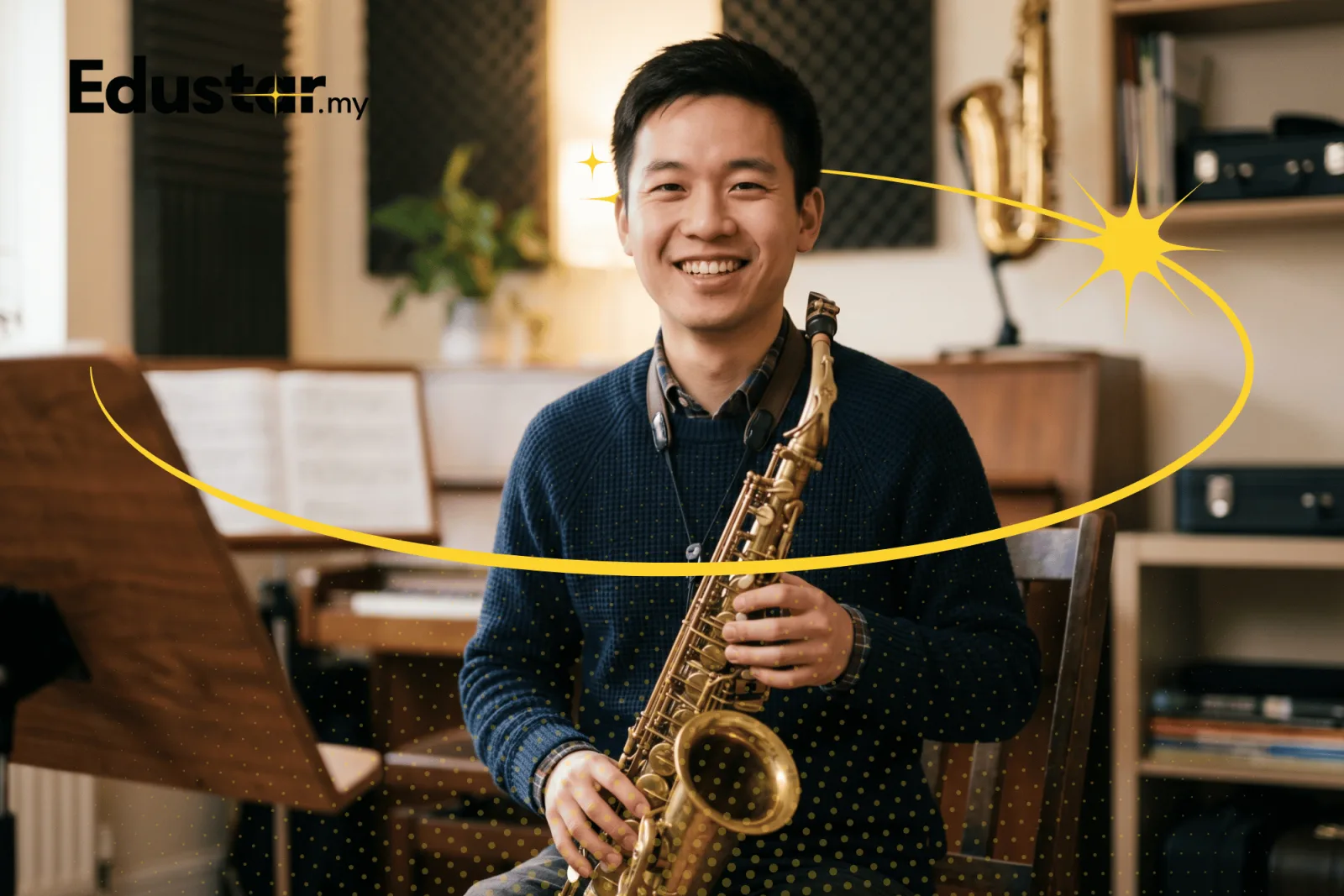
Saxophone tuition in Malaysia is year-round one-to-one coaching that grows the single-reed embouchure, air support, voicing, tone, technique, repertoire and exam readiness along one of three recognised pathways. The Anglo-classical route climbs ABRSM (Associated Board of the Royal Schools of Music) Woodwind Saxophone Grade 1 → Grade 8 → Diplomas (DipABRSM, LRSM, FRSM), or Trinity College London Woodwind Saxophone Initial → Grade 8 → ATCL / LTCL / FTCL — both universal grade boards with MY exam centres at Wisma Yayasan Selangor Petaling Jaya and various Yamaha + Stamford College venues, three sessions a year (March-April, July-August, November-December). The Yamaha Music School route runs an in-house woodwind curriculum at flagship centres in SS2 Petaling Jaya, Mid Valley Megamall and Bukit Tinggi Klang, with the Yamaha Grade Examination System (Grade 13 → Grade 5) beside or in place of ABRSM. The alto saxophone in E♭ is the standard first horn — a smaller mouthpiece, a lighter body and a gentler air demand than the tenor, sitting well with hand-span and lung capacity from age 9-10 upward. The horn ladder runs Yamaha YAS-280 student (around RM 5,500) → Yamaha YAS-480 intermediate (around RM 9,500) → Yamaha YAS-62 professional (around RM 18,000+), with Selmer Paris (Mark VI, Series II, Series III), Yanagisawa (WO Series) and Keilwerth at the pro tier. The reed shelf turns over constantly — Vandoren (Traditional / Java / V16), Rico (Royal / Plasticover / Select Jazz), or Légère synthetic, strength 2 → 3 → 3.5 from beginner to advanced. The school feeder is the wind band — the SK / SMK / SBP concert-band + marching-band co-curricular activity, with MSSM (Malaysia School Sports Council) Marching Band Competition state and national rounds and the annual Dataran Merdeka National Day parade. Past Grade 8 the MY tertiary pipeline opens at ASWARA (Akademi Seni Budaya dan Warisan Kebangsaan, Jalan Tun Ismail KL, under KPM) Diploma Muzik with a woodwind faculty, UCSI Institute of Music (formerly ICOM, a strong contemporary + jazz sax stream), UPSI Faculty of Music, UM Cultural Centre, UiTM Faculty of Music. MPYO (Malaysian Philharmonic Youth Orchestra, audition pathway under MPO based at DFP Dewan Filharmonik Petronas KLCC) places sax in orchestral repertoire (Ravel Boléro, Bizet L'Arlésienne, Mussorgsky-Ravel Pictures at an Exhibition). For the jazz and gigging learner the canon runs Charlie Parker alto, John Coltrane tenor + soprano, Sonny Rollins, Stan Getz, Cannonball Adderley; AJL (Anugerah Juara Lagu) session work and the wedding / corporate-gala freelance circuit (RM 1,500-5,000+ per gig in Klang Valley) keep the sax one of the most bookable horns in Malaysia.
- 01The alto in E♭ is the standard first horn — lighter, smaller-mouthpieced and gentler on the lungs than the tenor, workable from age 9-10; the B♭ tenor usually arrives at the Grade 3-4 transition
- 02ABRSM and Trinity College London are the two universal woodwind grade boards in MY — each publishes a Saxophone Grade 1-8 + Diploma syllabus and runs thrice-yearly exam rounds at MY centres (Wisma Yayasan Selangor PJ + Yamaha + Stamford College PJ)
- 03ABRSM Grade 5 Theory is a hard gate before Grade 6-8 Practical entry on sax — the same wall pianists hit; a coach clears the theory paper in parallel with Grade 4-5 Practical so the horn never stalls
- 04Trinity sets no Grade 5 Theory prerequisite and lets a candidate pick 3 repertoire pieces from a flexible list — a draw for MY families dodging the theory bottleneck and for repertoire-led players
- 05Yamaha YAS-280 (around RM 5,500) is the standard student alto; YAS-480 intermediate (around RM 9,500) suits Grade 4-5; YAS-62 professional (around RM 18,000+) by Grade 7-8; pro-tier alternatives Selmer Paris Mark VI / Series II / III, Yanagisawa WO Series, Keilwerth
- 06Reeds are the sax player's daily consumable — Vandoren (Traditional / Java / V16) and Rico (Royal / Plasticover / Select Jazz) cane, strength 2 → 2.5 → 3 → 3.5 from beginner to advanced; a Légère synthetic lasts longer and feels different, so the coach guides the choice
- 07The wind-band feeder — SK / SMK / SBP concert + marching band ko-kurikulum, the MSSM Marching Band Competition, the Dataran Merdeka National Day parade — is where many MY sax players first held the horn
- 08Jazz drives the pedagogy from Grade 5+ — Charlie Parker (alto, bebop, the Omnibook), John Coltrane (tenor + soprano, Giant Steps changes), Sonny Rollins (tenor, St. Thomas), Stan Getz (cool / bossa), Cannonball Adderley (alto, soul-jazz); method staples Larry Teal The Art of Saxophone Playing, Sigurd Raschèr Top Tones, Jamey Aebersold Vol. 1 / 24 / 54
- 09MY tertiary pipeline: ASWARA Diploma Muzik + Bachelor of Music (KPM, Jalan Tun Ismail KL) with a woodwind faculty; UCSI Institute of Music (formerly ICOM) and its strong jazz sax stream; UPSI Faculty of Music music-education track; UM Cultural Centre + UiTM Faculty of Music classical / performance
- 10MPYO (Malaysian Philharmonic Youth Orchestra) auditions at DFP Dewan Filharmonik Petronas KLCC under MPO at an ABRSM Grade 6+ baseline; AJL (Anugerah Juara Lagu) session work plus the wedding / corporate-gala circuit (RM 1,500-3,000 solo + backing track, RM 3,500-5,000+ live-band setup per gig in Klang Valley) keep the sax among the most bookable horns in MY
Who Saxophone tuition in Malaysia is for
We tune the tutor and the method to wherever the student really is: kids 9+ on alto, school marching band members, ABRSM / Trinity grade aspirants, and jazz or wedding-freelance adult learners.
Kids 9+ alto foundations (Year 3-6 first-time sax players)
Primary-school first exposure to saxophone, starting on alto in E♭ as the universal beginner standard. The child may be drawn in by school marching band, by a relative who plays, or by Kenny G / smooth-jazz background music at home. Coaching focus is embouchure (firm corners, relaxed lower lip), breath support from the diaphragm, reed assembly + care, hand position, the early ABRSM / Trinity Grade 1-3 Woodwind Saxophone repertoire, basic scales (C / F / G / B♭ concert one octave at Grade 1 expanding to two octaves at Grade 3), early theory (notation + the E♭ alto transposition), and a daily 20-45 minute practice habit. Suitable for SK, SJK(C), SJK(T), private and homeschool kids. Goal: clear Grade 3 by age 11-12, enjoy the instrument, decide whether to push toward the serious grade ladder + school band.
- Child loves the sound but practice at home is sporadic — needs a structured weekly target
- Parents bought a cheap alto from Shopee / Lazada and the tone + intonation are off — unsure if Yamaha YAS-280 is worth the upgrade
- Reeds keep cracking after a week — no one explained reed rotation or storage
- Don't know whether to pick ABRSM or Trinity for first exam — overwhelmed by music-school marketing
School marching band members (SK / SMK / SBP concert + marching band)
Already in the school marching band concert band or marching band, often started at age 10-13 through the ko-kurikulum activity. Strong on ensemble playing and band repertoire, often weaker on solo technique, scales, sight-reading and theory because school band rehearsal focuses on the next MSSM Marching Band Competition or Dataran Merdeka National Day parade. Coaching focus is filling the solo + technique + theory gaps with the ABRSM / Trinity grade ladder, so the student has a portable qualification beyond the school band. Tenor in B♭ often joins the alto by Grade 3-4 to slot into the concert-band tenor section.
- Solid in ensemble but solo technique + sight-reading are weak — school band practice doesn't cover these
- Wants to sit ABRSM Grade 4-5 but the school band conductor doesn't run an exam-prep track
- Stuck at Grade 5 because Grade 5 Theory paper was deferred — now blocked from Grade 6 Practical entry
- Wants to add tenor to alto for SBP / MRSM band squad but unsure how the transition works
ABRSM / Trinity grade aspirants (Form 1-5 + adults on the grade ladder)
Already through Grade 1-3 (or starting fresh as a focused adult), now committed to the grade ladder toward Grade 8 + Diploma. Coaching focus is the Grade 4-5 + Grade 6-8 syllabi (scales through all keys two-to-three octaves, full chromatic range, arpeggios in all inversions, exam repertoire across 3 contrasting style periods including Glazunov Saxophone Concerto / Ibert Concertino at Grade 7-8, Phil Woods / Paul Creston sonatas, altissimo register from Grade 7+), and crucially the ABRSM Grade 5 Theory paper before Grade 6 Practical entry. Often paired with school exams (PT3, SPM, IGCSE) which compress practice hours — coach helps schedule around exam season.
- Stuck at Grade 5 because Grade 5 Theory paper was deferred — now blocked from Grade 6 Practical entry on sax
- Altissimo register (high F♯ and above) is fragile — Grade 7-8 exam pieces demand reliable altissimo
- Practice time competes with SPM / IGCSE academic load — needs realistic weekly plan, not 'practise more'
- Want to switch from ABRSM to Trinity (or back) and don't know how the boards compare for tertiary audition at ASWARA / UCSI Institute of Music
Jazz hobbyists + wedding / AJL freelance aspirants (adults + older students)
Drawn to saxophone by Charlie Parker / John Coltrane / Sonny Rollins / Stan Getz / Kenny G / contemporary smooth jazz. May be a working professional picking up the instrument, an older student through Grade 5 wanting to add jazz improvisation, or someone targeting the wedding / corporate-gala freelance circuit (RM 1,500-5,000+ per gig in Klang Valley) and AJL (Anugerah Juara Lagu) / TV3 / Astro session work. Coaching focus is II-V-I changes, blues changes, rhythm changes in all twelve keys; the Charlie Parker Omnibook + John Coltrane Giant Steps changes + Sonny Rollins canon; Jamey Aebersold Vol. 1 + 24 + 54 play-along practice; wedding-circuit repertoire (Pachelbel Canon, Bach Air on the G String adapted, Ed Sheeran / Bruno Mars pop covers, Kenny G smooth-jazz cocktail standards).
- Can play classical exam pieces but freezes when asked to improvise over a blues — no improvisation framework
- Wants the wedding / corporate-gala booking flow but doesn't know what the standard set list and rate are in Klang Valley
- Plays tenor by ear, never had formal theory — wants to learn II-V-I changes properly
- Adult restarter — used to play in school marching band, wants to pick up sax again at age 30-40 but not from absolute scratch
What saxophone tuition covers
The saxophone journey runs across three modules. Beginner foundations (Grade 1-3 alto, embouchure, breath, early theory), then intermediate (Grade 4-5, Grade 5 Theory, the Larry Teal method), then advanced (Grade 6-8, jazz improvisation, Diploma, MPYO / MPO audition prep).
Beginner foundations — Grade 1-3 alto + embouchure + breath + early theory (kids 9+ / first-time adults)
The first horn is the alto in E♭, and the first weeks go to assembling the mouthpiece, ligature and a soaked cane reed, then setting the lower-lip cushion and diaphragm air behind the ABRSM / Trinity Grade 1-3 exam pieces. The alto wins out at this age because its smaller mouthpiece and lighter air load match a 9-12 year-old's lungs. A coach locks in a daily 20-45 minute routine and talks straight about how fast reeds wear out.
Saxophone basics — neck-strap fit, mouthpiece + reed + ligature assembly, embouchure (firm corners + relaxed lower lip + chin pulled flat), breath support from the diaphragm (not the chest), tonguing (light 'too' or 'doo' articulation at the reed tip); reed care — soak before play, store flat in a Vandoren-style holder, rotate 3-4 reeds, strength 2 → 2.5 typical Grade 1-2; first long-tones at concert B♭ / G major scale; major scales (C, F, G, B♭ concert — alto reads E♭ transposed) one octave at Grade 1 expanding through Grade 3; arpeggios + broken-chord patterns at Grade 2-3; ABRSM / Trinity Grade 1-3 Woodwind Saxophone exam repertoire (3 pieces from the syllabus list per grade — typically a Baroque / Classical adaptation + a Romantic or 20th-century original + a contrasting jazz or contemporary idiom); ABRSM Grade 1-3 Music Theory paper (note values, time signatures, simple keys including the E♭ alto transposition, intervals, tonic triads, basic Italian terms); sight-reading at grade level (8 bars at Grade 1, 16 bars at Grade 3); aural tests (rhythm clap-back, pitch recognition, character description); first ensemble experience at the school marching band concert band or a Yamaha Music School centre showcase; instrument choice — Yamaha YAS-280 student alto (around RM 5,500) is the standard entry, Jupiter JAS-700 / Mendini alternatives at lower price; the Cannonball-style fancy finishes look great but tone is no better at this band; Vandoren Traditional 2 or Rico Royal 2 reeds the typical starting strength.
Intermediate — Grade 4-5 + Grade 5 Theory gate + scales + Larry Teal method
This is the stretch where most MY woodwind players stall, so a coach times the ABRSM Grade 5 Theory paper to land alongside Grade 4-5 Practical, builds full chromatic fingering, cracks open the altissimo register above high F, and opens the Larry Teal The Art of Saxophone Playing studies. Jazz-track students often add the B♭ tenor to the alto around Grade 4 here.
Scales at Grade 4-5 — major + harmonic minor + melodic minor through 4 sharps / 4 flats, two octaves, chromatic scale full range (low B♭ to high F), scales in thirds at Grade 5; arpeggios + dominant 7th + diminished 7th broken-chord patterns in all twelve keys; long-tones programme (Sigurd Raschèr Top Tones for the Saxophone — for tone control and the altissimo register from high F♯ up); ABRSM Grade 4-5 Woodwind Saxophone exam repertoire (3 contrasting pieces — Baroque / Classical sonata movement adapted + Romantic character piece + 20th-century / jazz idiom such as Phil Woods Sonata or a Garmusic study); Grade 4-5 sight-reading (24-32 bars, simple key signatures, basic chromatic touches, syncopation); Grade 5 aural — sing back a sequence, identify chords I / IV / V / vi, identify cadences (perfect / plagal / imperfect / interrupted); **ABRSM Grade 5 Music Theory paper** as a separate exam — keys to 6 sharps / 6 flats, all triads + first / second inversion, four-part chord progressions, melodic composition, transposition (especially relevant for sax players since alto + tenor are transposing instruments), ornaments, basic harmonic analysis; Trinity Grade 5 candidates bypass theory gate but typically still take ABRSM Grade 5 Theory for tertiary audition readiness; Larry Teal The Art of Saxophone Playing method studies — daily warm-up routine, articulation patterns, scale variations; introduction to vibrato (jaw vibrato from the diaphragm, controlled at ~5-6 Hz); reed strength typical 2.5 → 3 at this band; instrument transition — Yamaha YAS-480 intermediate alto (around RM 9,500) becomes worth the upgrade by Grade 4-5 for the more even response across registers; tenor in B♭ (Yamaha YTS-280 student tenor around RM 7,500) often joins for jazz-track students by Grade 4-5.
Advanced — Grade 6-8 + jazz improvisation + Diploma DipABRSM / ATCL + MPYO / MPO + tertiary audition prep
The professional band. Grade 6-8 demands serious altissimo register, full chromatic + scale-pattern fluency, substantial repertoire across classical and jazz, and 60-120+ minutes daily practice. Jazz improvisation comes in seriously via Charlie Parker (Omnibook), John Coltrane (Giant Steps changes), Sonny Rollins. Diploma — DipABRSM, LRSM, ATCL, LTCL — opens ASWARA / UCSI Institute of Music / UPSI tertiary auditions and MPYO orchestral audition.
Grade 6-8 scales — all major + harmonic minor + melodic minor through all keys, two-to-three octaves, scales in thirds + sixths at Grade 8, full chromatic range from low B♭ to altissimo F♯ / G; altissimo register (high F♯ → G → A → C above the staff) for Grade 7-8 + Diploma — Sigurd Raschèr Top Tones method; full arpeggios — root + first inversion + second inversion, dominant 7th + diminished 7th in all keys; vibrato control (variable speed + intensity); Grade 6-8 exam repertoire (3 contrasting pieces — Baroque adaptations of Bach Cello Suites / Marcello Oboe Concerto; Classical / Romantic concertos — Glazunov Saxophone Concerto, Ibert Concertino da Camera; 20th-century / contemporary — Phil Woods Sonata, Paul Creston Sonata, Ronald Binge Concerto, Eugene Bozza pieces, John Harle); ABRSM Grade 6-8 Theory paper (figured bass, four-part harmony, melody writing, score-reading); sight-reading at Grade 8 (full one-page piece including modulation, chromatic harmony); aural at Grade 8 (identify cadence + modulation + period); **DipABRSM** (Diploma in Music Performance) — 35-minute programme of 3-4 pieces + viva voce + sight-reading + quick study; **LRSM** (Licentiate) — 50-minute professional-level programme + viva; **Trinity ATCL** (Associate of Trinity College London) and **LTCL** (Licentiate) — parallel diploma ladder, repertoire-focused without compulsory technical exercises; jazz improvisation track — Jamey Aebersold Vol. 1 (How to Play Jazz) + Vol. 24 (Major & Minor) + Vol. 54 (Maiden Voyage) play-along; Charlie Parker Omnibook transcribed solo learning ('Ornithology', 'Donna Lee', 'Confirmation', 'Now's the Time') — alto repertoire core; John Coltrane Giant Steps changes + 'Naima' + 'My Favorite Things' soprano sax — tenor repertoire core; Sonny Rollins 'St. Thomas' + 'Tenor Madness'; Stan Getz cool / bossa repertoire ('Desafinado', 'The Girl from Ipanema'); Cannonball Adderley soul-jazz; II-V-I changes in all twelve keys, blues changes, rhythm changes; tertiary audition prep for ASWARA Bachelor of Music + UCSI Institute of Music (formerly ICOM) jazz sax stream + UPSI Faculty of Music + UM Cultural Centre + UiTM Faculty of Music; MPYO (Malaysian Philharmonic Youth Orchestra) audition prep — orchestral excerpts from Ravel Boléro, Bizet L'Arlésienne suites, Mussorgsky-Ravel Pictures at an Exhibition, Gershwin Rhapsody in Blue, Bernstein West Side Story; freelance / wedding-circuit repertoire — pop covers (Ed Sheeran 'Perfect', Bruno Mars), cocktail-hour smooth jazz (Kenny G repertoire), wedding standards (Pachelbel Canon, Bach Air on the G String adapted, 'A Thousand Years'); instrument upgrade — Yamaha YAS-62 professional (around RM 18,000+) standard for Grade 7-8 + Diploma; pro-tier Selmer Paris (Mark VI legacy, Series II Jubilee, Series III Reference), Yanagisawa WO Series, Keilwerth at RM 35,000-90,000+ depending on model and vintage.
From first call to first saxophone lesson
How Saxophone tuition with Edustar gets going: diagnostic first, then exam board and instrument choice, then weekly drilling.
- 1
Free needs assessment (Day 0)
Share the student's age (kids 9+ / school-age / adult learner), prior experience (none / school marching band / current grade), instrument at home (Yamaha YAS model / borrowed school horn / nothing yet), exam board target (ABRSM / Trinity / Yamaha / undecided), pathway intent (classical exam ladder / jazz improvisation / wedding-freelance / orchestral), practice time available per week. We brief honestly on the alto-first beginner standard, the reed economy, the Yamaha YAS instrument ladder, and the realistic exam-by-exam timeline (~12 months per grade at the Grade 4-8 band).
~15 min - 2
Diagnostic — embouchure check + short play assessment + theory snapshot
The tutor runs a short 20-minute diagnostic: embouchure observation (firm corners, lower-lip flat over teeth, chin pulled flat, throat open), a breath-support check, current scales repertoire, one prepared piece, sight-reading at the appropriate level, a quick theory snapshot (key signatures including the E♭ alto / B♭ tenor transposition). For absolute beginners the diagnostic is replaced by an embouchure + breath introduction. Output: clear placement on the ABRSM / Trinity / Yamaha ladder, the 3-4 weaknesses (embouchure tightness, breath shallowness, scale gaps, theory holes, repertoire balance) the next 6-12 months will target.
Before lesson 1 - 3
Tutor matching (board + level + style + temperament)
We pick a tutor tuned to the chosen exam board (ABRSM-specialist vs Trinity-specialist vs Yamaha-trained), the student's current grade, the style focus (classical exam-track vs jazz improvisation vs wedding-circuit freelance), and temperament: patient kids-specialists for the 9-12 band, ABRSM Diploma-holding tutors for Grade 6-8 + DipABRSM track, AJL / wedding-freelance veterans for adult students targeting gigging income, MPYO / ASWARA-aligned tutors for orchestral / tertiary track. In-person across Klang Valley, Penang, Johor; online nationwide via Zoom (top-down camera setup for embouchure + finger observation).
1-3 days - 4
First lesson — board choice + instrument check + weekly plan
Lesson 1 anchors to the exam board decision (if not yet decided), instrument inspection (pads, neck-cork fit, mouthpiece + reed assembly), and the weekly practice plan. For beginners: embouchure + breath + reed care + first long-tones at concert B♭ + first 5-note pattern. For Grade 1-3: scales review + first exam piece selection from the current syllabus + Grade 1-3 theory drilling start. For Grade 4-5: scales gap-fill + chromatic + altissimo introduction + Grade 5 Theory paper plan + 3 exam pieces selected. For Grade 6-8: full repertoire programme across Baroque adaptation / Classical concerto / 20th-century or jazz + altissimo register work + scales in all keys plan. For jazz track: II-V-I changes + first Aebersold Vol. 1 play-along + first Parker Omnibook transcription. For Diploma: 35-minute recital programme of 3-4 pieces with viva voce prep.
Lesson 1 - 5
Weekly drilling — long-tones + scales + repertoire + theory
Weekly 45-60 minute sessions. Standard split: (a) long-tones + warm-up (5-10 min) — Sigurd Raschèr Top Tones method at Grade 5+; (b) scales + arpeggios at the grade level (10-15 min); (c) sight-reading + aural drills (5-10 min); (d) repertoire piece work — typically rotating across 2-3 exam pieces or jazz standards (25-35 min); (e) theory paper drilling alongside (especially Grade 3-5 → Grade 5 paper). Between sessions: daily practice at the grade-appropriate hours (~20-30 min Grade 1 → ~60-120 min Grade 8). Monthly recording of one piece for self-review. Reed rotation discipline reinforced — 3-4 reeds at a time, store flat, replace every 2-3 weeks.
Ongoing — weekly - 6
Exam round prep — final 6-8 weeks before the ABRSM / Trinity round
Each ABRSM / Trinity round runs three times yearly (March-April / July-August / November-December). From 6-8 weeks before the round, focus shifts to exam-day readiness — full mock exams (3 pieces back-to-back at performance tempo + scales + sight-reading + aural), exam-format sight-reading drills, exam-venue logistics brief (Wisma Yayasan Selangor PJ + Yamaha + Stamford College PJ venues), and recording-grade run-throughs. New reed broken in 7-10 days ahead for exam day. For Diploma: full 35-minute (DipABRSM) or 50-minute (LRSM / ATCL) recital programme mocks + viva voce prep. For MPYO audition track: orchestral excerpt drilling at performance tempo with metronome and audio reference.
Final 6-8 weeks pre-exam - 7
Post-exam review + next-grade or career planning
Within 4-6 weeks of result release, tutor and student review the mark breakdown — pieces, scales, sight-reading, aural, theory — and identify what the next grade or next career step needs to target. Next-grade syllabus selection (repertoire short-list, scale targets), instrument upgrade decision (YAS-280 → YAS-480 at Grade 4, YAS-480 → YAS-62 or Selmer / Yanagisawa pro-tier at Grade 7-8), tenor add-on for jazz / SBP band track, MPYO audition cycle planning, freelance / wedding-circuit set list building. Multi-year plan updated: typical ladder ~12 months per grade, with Diploma + tertiary + MPYO + AJL / wedding-freelance as the optional advanced tracks.
4-6 weeks post-result
Things parents ask us first
Alto first — the universal beginner standard for under-13s
Alto saxophone in E♭ is the universal beginner standard, not tenor. The reasons are mechanical: alto has a smaller mouthpiece (less embouchure strain), a shorter body (suits hand-span from age 9-10), and lower air demand (suits developing lung capacity), and the alto is the lead voice in school marching band concert-band repertoire so the student sees immediate ensemble use. Tenor in B♭ usually joins by Grade 3-4 for jazz-track students once embouchure and breath are established. Soprano in B♭ (curved or straight) demands advanced intonation control and is rarely a starting instrument. Baritone in E♭ needs physical maturity for the size and air demand. Coaches insist on alto first even when the student says they want tenor because of Coltrane — the alto foundation transfers directly to tenor and the reverse path is much harder.
Grade 5 Theory prerequisite — sax players hit the same gate as pianists
ABRSM enforces the same rule for woodwind that it does for piano: candidates entering Grade 6, 7 or 8 Practical on saxophone must first hold a pass in ABRSM Grade 5 Theory (or ABRSM Grade 5 Practical Musicianship, or Trinity Grade 5 Theory). The single most common pattern: a sax player passes Grade 5 Practical, defers the theory paper because 'it's only theory', then sits stalled for 1-2 years before realising they cannot enter Grade 6. Coaches build the Grade 5 Theory syllabus in parallel from Grade 3-4 — keys to 6 sharps / 6 flats, triads + inversions, four-part progressions, transposition (especially relevant since alto + tenor are transposing instruments and reading concert pitch is a Grade 5 Theory skill), ornaments — so the paper is taken in the same exam round as Grade 5 Practical, not afterwards. Trinity does not impose this gate, which is one of the reasons MY families switch to Trinity at the Grade 5 decision point.
Reed economy — Vandoren / Rico strength ladder, not 'just one reed'
The single most expensive sax beginner mistake is using one cracked or warped reed for months. Reeds are consumables — typical lifespan 2-3 weeks of daily practice. Standard reed brands in MY: Vandoren (Traditional / Java / V16 cuts) and Rico (Royal / Plasticover / Select Jazz). Strength ladder: 2 → 2.5 → 3 → 3.5 across the beginner-to-advanced ladder; Grade 1-2 typically Vandoren Traditional 2 or Rico Royal 2; Grade 4-5 typically 2.5 → 3; Grade 6-8 + Diploma 3 → 3.5. Rotate 3-4 reeds at a time — wet one, play 15 minutes, swap to the next — so the cane recovers between sessions. A Légère synthetic reed (around RM 150-200 per reed) is an alternative for adults who hate the cane economy and play 2-3x weekly; tone is consistent but feels different. Coaches brief reed care during Lesson 1.
Yamaha YAS instrument ladder — student → intermediate → professional
The standard MY saxophone instrument ladder runs Yamaha YAS-280 student alto (around RM 5,500) at Grade 1-3, Yamaha YAS-480 intermediate (around RM 9,500) by Grade 4-5 for the more even response across registers, Yamaha YAS-62 professional (around RM 18,000+) by Grade 7-8 + Diploma. The YAS-280 → YAS-480 jump is real (tone consistency + intonation centre) and worth it; the YAS-480 → YAS-62 jump is more subtle and only matters at Grade 7+ where altissimo register and dynamic range become exam criteria. Pro-tier alternatives at the RM 35,000-90,000+ band — Selmer Paris (Mark VI legacy 1954-1974 used; Series II Jubilee; Series III Reference 54), Yanagisawa WO Series, Julius Keilwerth — are typically the choice of teaching-professional or full-time freelance sax players. Many MY students rent or buy second-hand at the intermediate band; second-hand YAS-280 typically RM 3,000-4,000, YAS-480 RM 6,500-7,500 if pads and resonators are intact.
marching band school band — the MY sax player feeder pipeline
Most MY saxophone players first picked up the horn through marching band — the SK / SMK / SBP concert-band + marching-band ko-kurikulum activity. MSSM (Malaysia School Sports Council) hosts state and national Marching Band Competition competitions; the National Day Dataran Merdeka parade features school + military bands annually; SBP Fully Residential School (SBP Integrasi Selandar, SBP Gopeng) and MRSM band squads are competitive feeder pipelines. A concert-band sax section typically runs 2-3 alto + 2 tenor + 1 baritone, so kids who learn alto first slot in immediately. The school band route gives early ensemble experience and group discipline; 1-to-1 tuition with Edustar runs in parallel to build the ABRSM / Trinity grade ladder and exam-track repertoire that school band practice does not cover. Many of the strongest MY adult sax players combine school-band background + 1-to-1 Grade 1-8 + tertiary at ASWARA / UCSI Institute of Music.
MY tertiary + MPYO + AJL / wedding freelance — where Grade 8 leads
Beyond Grade 8 + DipABRSM / ATCL, the MY tertiary pathway runs through ASWARA (Akademi Seni Budaya dan Warisan Kebangsaan, Jalan Tun Ismail KL, under KPM) Diploma Muzik + Bachelor of Music with a woodwind faculty; UCSI Institute of Music (formerly ICOM, International College of Music) with its strong jazz and contemporary sax stream; UPSI Faculty of Music for the music-education track; UM Cultural Centre and UiTM Faculty of Music for classical / performance. MPYO (Malaysian Philharmonic Youth Orchestra) under MPO at DFP Dewan Filharmonik Petronas KLCC features sax in orchestral repertoire — Ravel Boléro, Bizet L'Arlésienne, Mussorgsky-Ravel Pictures at an Exhibition — with annual audition at ABRSM Grade 6+ baseline. The professional freelance circuit makes sax one of the most bookable instruments in MY: AJL (Anugerah Juara Lagu) session work, TV3 / Astro music productions, the wedding / corporate-gala circuit (typical Klang Valley rates RM 1,500-3,000 per gig for solo sax + backing track, RM 3,500-5,000+ for full live-band setup, higher tier at 5-star hotel ballroom events). Many MY sax players run a teaching + freelance gigging dual track.
What Saxophone tuition with Edustar covers
Honest scope — no guaranteed grade marks, just structured year-round ABRSM / Trinity / Yamaha-aligned coaching.
Age 9 – adult
Levels supported (beginner alto to Diploma)
ABRSM + Trinity + Yamaha
Exam boards coached (Grade 1-8 + Diplomas)
Grade 1 → DipABRSM / ATCL
Pathway range (entry grade to professional diploma)
Nationwide
In-person or online
How Saxophone tuition fits into the Malaysian music pathway
From first alto pickup to Diploma + tertiary + MPYO + freelance gigging — a multi-year ladder across ABRSM / Trinity grade boards plus the marching band school feeder.
- 01
Ages 9-12 (first exposure — alto Grade 1)
First saxophone lessons on alto in E♭ — the universal beginner standard. The student may already be in the school marching band concert band or starting fresh at home. Yamaha YAS-280 student alto (around RM 5,500) is the standard entry instrument; Jupiter JAS-700 or second-hand YAS-280 at RM 3,000-4,000 are valid alternatives. Vandoren Traditional 2 or Rico Royal 2 reeds. Goal: embouchure + breath support + reed care habit, first scales (C / F / G concert one octave), first simple Grade 1 repertoire, daily 20-30 minute practice.
- 02
Ages 11-14 (Grade 1-3 + early theory + marching band ensemble)
ABRSM / Trinity Grade 1-3 exam ladder, typically ~12 months per grade. Scales expand to two octaves (Grade 3); arpeggios + broken chord patterns start at Grade 2-3. Repertoire from the published syllabus per round (March-April / July-August / November-December at Wisma Yayasan Selangor PJ + Yamaha + Stamford College PJ venues). Early Music Theory paper (Grade 1-3) sat alongside Practical — alto and tenor transposition introduced. First ensemble experience at school marching band concert band, MSSM Marching Band Competition state-level participation. Practice hours ~20-45 min daily.
- 03
Ages 13-16 / Form 1-3 (Grade 4-5 + Grade 5 Theory gate + tenor add-on)
Intermediate band. Grade 4-5 scales through 4 sharps / 4 flats two octaves, full chromatic range, arpeggios in all inversions, scales in thirds at Grade 5; long-tones + altissimo introduction; Sigurd Raschèr Top Tones method. ABRSM Grade 5 Music Theory paper must be cleared before Grade 6 Practical entry — the same gate that stalls piano students; transposition skill is core (alto + tenor are transposing instruments). Trinity students bypass this but typically still take Grade 5 Theory for tertiary audition readiness. Yamaha YAS-480 intermediate alto (around RM 9,500) transition recommended by Grade 4-5. Tenor in B♭ (Yamaha YTS-280 student around RM 7,500) often added for jazz-track students. Practice hours ~45-60 min daily. PT3 academic pressure — practice schedule needs protecting.
- 04
Form 4-5 (Grade 6-8 + jazz improvisation + SPM academic balance)
Advanced grades. Grade 6-8 syllabus demands all scales through all keys two-to-three octaves, altissimo register (high F♯ → G → A → C), substantial repertoire (Glazunov Saxophone Concerto, Ibert Concertino da Camera, Phil Woods Sonata, Paul Creston Sonata, Eugene Bozza). ABRSM Grade 6-8 Theory paper sat alongside. Jazz improvisation track starts seriously — II-V-I changes, blues changes, rhythm changes; Charlie Parker Omnibook ('Ornithology', 'Confirmation'); John Coltrane Giant Steps changes if on tenor / soprano. SPM academic pressure compresses practice — coach helps balance. Practice hours target 60-120 min daily at Grade 7-8. Aim: clear Grade 8 by end of Form 5 / Lower Sixth. Yamaha YAS-62 professional or pro-tier Selmer Paris / Yanagisawa upgrade for Grade 7-8.
- 05
Post-SPM / Pre-U + Diploma (DipABRSM / ATCL / LRSM / LTCL) + MPYO audition
Diploma level. DipABRSM (Diploma in Music Performance) is a 35-minute recital programme (3-4 pieces from Diploma syllabus — typically a Baroque adaptation + a Classical concerto movement + a contemporary jazz idiom + a contrasting piece) + viva voce + sight-reading + quick study. LRSM (Licentiate) extends to 50-minute professional-level programme + viva. Trinity ATCL → LTCL → FTCL parallel. MPYO (Malaysian Philharmonic Youth Orchestra) audition prep — orchestral excerpts from Ravel Boléro, Bizet L'Arlésienne, Mussorgsky-Ravel Pictures at an Exhibition, Gershwin Rhapsody in Blue. Practice hours 2-3+ daily. Many candidates use the SPM → STPM / Matrikulasi gap year for intensive Diploma + MPYO audition preparation.
- 06
Tertiary + freelance / orchestral / teaching (ASWARA / UCSI Institute of Music / UPSI / MPO / AJL session)
Bachelor of Music / Diploma Muzik admission at ASWARA (Jalan Tun Ismail KL, Diploma Muzik + Bachelor of Music under KPM, woodwind faculty), UCSI Institute of Music (formerly ICOM, classical + jazz sax stream), UPSI Faculty of Music (music education), UM Cultural Centre, UiTM Faculty of Music. Audition typically expects ABRSM Grade 8 + DipABRSM (or Trinity ATCL) + a live audition piece + interview. From here: MPYO permanent member → MPO auxiliary engagement at DFP Dewan Filharmonik Petronas KLCC; AJL (Anugerah Juara Lagu) session work, TV3 / Astro music production; wedding / corporate-gala freelance circuit at Klang Valley 5-star hotel ballrooms (RM 1,500-3,000 solo + backing track, RM 3,500-5,000+ live-band setup per gig); professional teaching at Yamaha Music School / UCSI / private studios; postgraduate study abroad (Royal Academy of Music London, Royal College of Music, Berklee, North Texas, Manhattan School of Music).
Frequently Asked Questions
The questions Malaysian parents, students and adult learners most often ask about saxophone tuition.
Start Saxophone tuition with Edustar
One free needs assessment, then a saxophone tutor slotted in within three days. ABRSM-, Trinity- or Yamaha-aligned, an alto-first beginner standard, Grade 1-8 through Diploma plus jazz improvisation, delivered across the country in person or online.
- Free needs assessment + short play diagnostic + embouchure check
- ABRSM / Trinity / Yamaha-track instructors matched by board + level + style + temperament
- Sequenced curriculum: long-tones + scales + repertoire + sight-reading + aural + theory
- Grade 5 Theory paper built into Grade 3-4 plan (no Grade 6 entry stall)
- Jazz improvisation + wedding-circuit repertoire add-on for adult / freelance track
- Home or online — nationwide
Edustar — Malaysian private tuition, KPM-aligned tutors.