Accordion Tuition in Malaysia
Accordion tuition in Malaysia is 1-to-1 coaching against Trinity College London Piano Accordion Grade Initial to Grade 8 plus ATCL / LTCL Diplomas, the principal grade ladder, because ABRSM does NOT offer accordion as a standalone practical. Coaches map bellows control, right-hand keyboard, Stradella or free-bass left hand, and repertoire across Dondang Sayang heritage, tango, klezmer, jazz and classical.
What is Accordion Tuition?
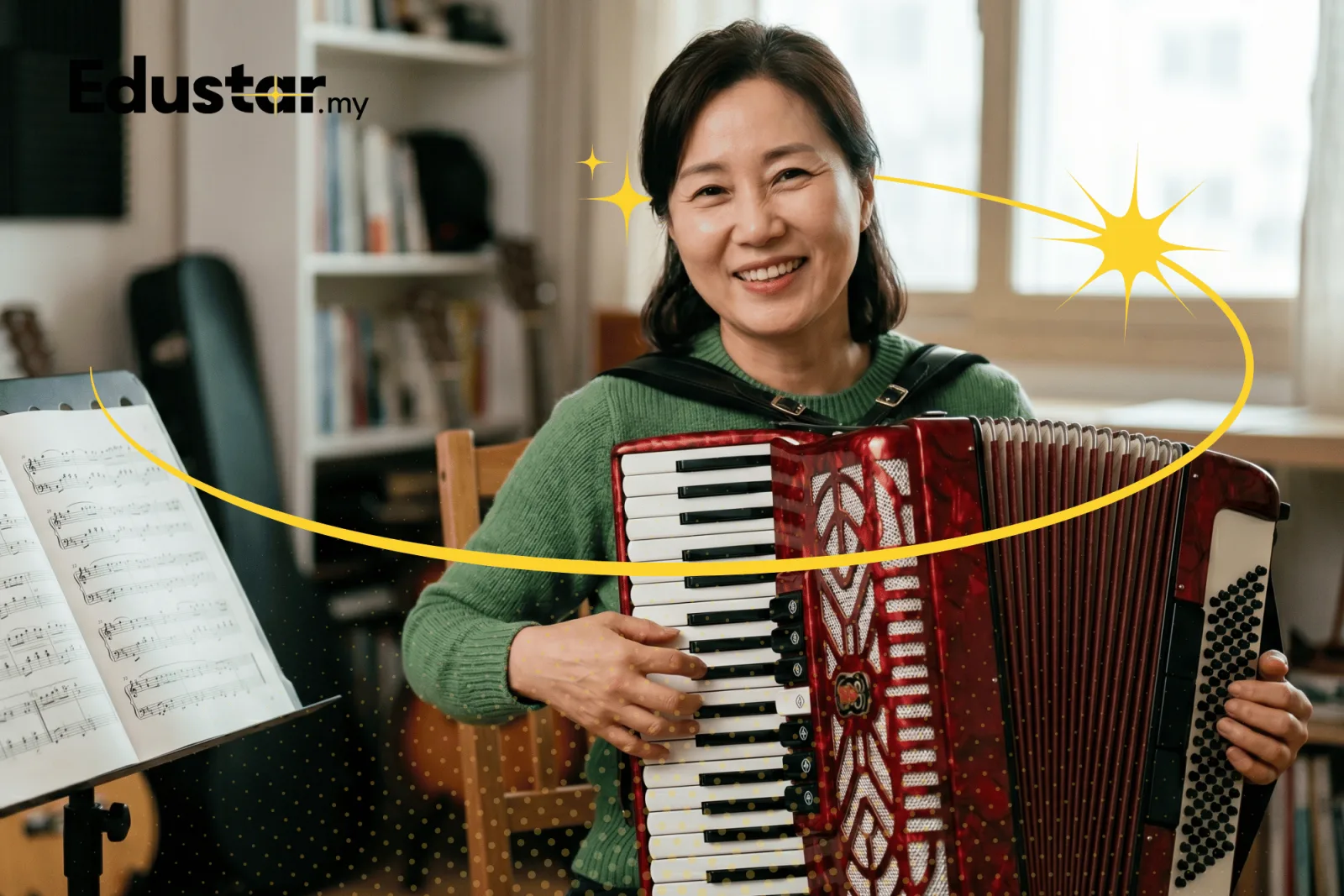
Accordion tuition in Malaysia is year-round 1-to-1 coaching that builds bellows technique, right-hand piano-keyboard fluency, left-hand bass-system control, and a working repertoire across classical, folk-heritage, jazz / tango, and popular idioms. Unlike piano or violin, accordion has only ONE recognised graded board in wide MY use: Trinity College London Piano Accordion (Grade Initial → Grade 8 → ATCL / LTCL / FTCL Performance Diplomas). ABRSM does NOT publish an accordion practical syllabus, only ABRSM Music Theory Grade 1-8 is usable as theory grounding alongside Trinity practical. London College of Music (LCM) Piano Accordion Grade 1-8 + DipLCM is a secondary option some MY teachers prefer for contemporary repertoire flexibility. The instrument-choice landscape is dominated by Hohner (Bravo II/III entry RM 4,500-9,000, Nova II/III intermediate RM 9,000-16,000, Morino IV/V Artiste professional RM 18,000-35,000+, distributed via Sole Music Sdn Bhd KL, Bentley Music Mont Kiara / Mid Valley, Music Bliss Subang Jaya) and increasingly Roland FR-series digital accordion (FR-1x entry RM 8,500-10,000, FR-4x mid RM 14,000-17,000, FR-8x top RM 28,000-35,000, distributed via Roland Malaysia / Bentley Music): the digital advantage in MY urban condo / apartment living is real: no tuning maintenance, headphone-silent practice, instant Stradella or free-bass switch on the FR-8x. The bass-system decision is consequential: standard Stradella (120-button root + counterbass + major / minor / 7th / dim chord buttons) suits Dondang Sayang heritage, Joget, Asli, tango, French and Eastern European folk; free-bass / Convertor (chromatic single-note left hand) is required for Trinity Grade 6+ classical polyphony (Bach, Scarlatti) and ATCL classical-track diplomas. MY heritage repertoire centres on Dondang Sayang, the Melaka Malay pantun-music tradition inscribed on the UNESCO Representative List of the Intangible Cultural Heritage of Humanity in 2018, where accordion has joined violin (biola), rebana frame drum and gong since the early-20th-century Portuguese / Eurasian Kristang influence. Heritage transmission runs through Persatuan Dondang Sayang Pusaka Negeri Melaka, Persatuan Pemuzik Tradisional Malaysia (PPTM), and JKKN (Jabatan Kebudayaan dan Kesenian Negara) under MOTAC. ASWARA (Akademi Seni Budaya dan Warisan Kebangsaan, Jalan Tun Ismail KL, under KPM) Fakulti Muzik includes accordion as an ensemble instrument in heritage repertoire courses, not a standalone principal study. Performance outlets run from KLPAC (Sentul West) world-music nights, DPAC (Damansara Performing Arts Centre, Empire Damansara) tango / klezmer programmes, penangpac (Straits Quay) heritage showcases, to KL street busker scene at Bukit Bintang and Petaling Street (DBKL-licensed busking pilot) and Penang Lebuh Armenian (MBPP heritage zone), where the accordion's portability and unamplified loudness make it a signature busker instrument. Edustar matches a tutor calibrated to the student's goal: Trinity classical track, Dondang Sayang heritage track, tango / klezmer / folk track, jazz / popular track, or busker freelancer self-accompaniment.
- 01Trinity College London Piano Accordion (Grade Initial → Grade 8 + ATCL / LTCL / FTCL) is the principal grade ladder used in MY, ABRSM does NOT publish an accordion practical syllabus (callout warning below)
- 02London College of Music (LCM) Piano Accordion Grade 1-8 + DipLCM is the secondary board, preferred by some MY teachers for contemporary repertoire flexibility
- 03Stradella vs free-bass decision: standard 120-button Stradella (root + counterbass + chord buttons) suits Dondang Sayang / Joget / Asli / tango / folk; free-bass (Convertor) chromatic single-note left hand is required for Trinity Grade 6+ classical and ATCL classical track
- 04Hohner is the dominant acoustic brand in MY: Bravo II/III entry (RM 4,500-9,000), Nova II/III intermediate (RM 9,000-16,000), Morino IV/V Artiste professional (RM 18,000-35,000+), distributed via Sole Music Sdn Bhd, Bentley Music, Music Bliss
- 05Roland FR-series digital accordion is the urban-MY game-changer: FR-1x entry (RM 8,500-10,000), FR-4x mid (RM 14,000-17,000), FR-8x top with full free-bass + orchestral voices (RM 28,000-35,000); no tuning maintenance, headphone-silent practice, switchable Stradella ↔ free-bass on FR-8x
- 06Dondang Sayang (Melaka Malay pantun-music tradition inscribed UNESCO Intangible Cultural Heritage 2018) features accordion alongside biola (violin), rebana and gong; heritage transmission via Persatuan Dondang Sayang Pusaka Negeri Melaka + JKKN MOTAC
- 07ASWARA (Akademi Seni Budaya dan Warisan Kebangsaan, Jalan Tun Ismail KL, under KPM) Fakulti Muzik includes accordion as an ensemble instrument in heritage and traditional repertoire courses, not as standalone principal study
- 08Practice-hours ladder per Trinity grade: Grade Initial-1 ~20-30 min daily, Grade 2-3 ~30-45 min, Grade 4-5 ~45-60 min, Grade 6-7 ~60-90 min, Grade 8 ~90-120 min, ATCL Diploma 2-3+ hours daily
- 09Performance venues: KLPAC (Sentul West), DPAC (Damansara Performing Arts Centre, Empire Damansara), penangpac (Straits Quay); KL busker zones at Bukit Bintang and Petaling Street (DBKL-licensed) + Penang Lebuh Armenian (MBPP heritage zone)
- 10Adjacent repertoire traditions MY accordionists explore: Tango Argentino (Piazzolla, Troilo, Gardel), Klezmer (freylakh, doina, sher), Cajun / Zydeco, French musette, Eastern European folk crossover
Who accordion tuition in Malaysia is for
The tutor and the track are set to where each student stands: heritage learners on Dondang Sayang and folk, tango and Latin enthusiasts, hobbyists chasing favourite pieces, and busker freelancers assembling a working performance set.
Heritage learners, Dondang Sayang + Asli + Joget + Inang traditional MY ensemble track
Learners committed to Malaysian musical heritage transmission as the primary goal. Often Melaka-rooted families with multi-generational Dondang Sayang background, or ASWARA Fakulti Muzik students taking traditional-ensemble courses, or PPTM (Persatuan Pemuzik Tradisional Malaysia) members. Coaching focus is the Dondang Sayang harmonic 'lagu' frameworks (Lagu Dondang Sayang, Lagu Asli, Lagu Inang), characteristic ornaments (slow ornamented melisma, drone-and-call structure), ensemble role alongside biola (violin) + rebana + gong, slow rubato phrasing, and call-and-response idiom with the singer / pantun reciter. Stradella bass throughout, no free-bass needed for this track. Performance outlets at JKKN MOTAC heritage events, Melaka state cultural showcases, KLPAC heritage nights, penangpac heritage programmes. Goal: become a competent ensemble member in traditional MY repertoire, not a solo recitalist.
- Want to honour family tradition (grandfather played biola in a Dondang Sayang ensemble) but can't find a Melaka-based tutor matching schedule
- ASWARA Diploma Muzik enrolment requires Dondang Sayang ensemble familiarity, need intensive preparation before audition
- Online lessons feel wrong for this track, call-and-response idiom and ensemble timing don't transfer through Zoom; need in-person Melaka or KL access
- Family owns a vintage Hohner Bravo II handed down from an uncle, needs servicing / tuning advice from someone who knows accordion repair in MY
Tango / Latin enthusiasts, Piazzolla / Troilo / Gardel + klezmer + French musette + folk crossover
Adult learners drawn to the accordion through Tango Argentino (Astor Piazzolla Nuevo Tango (Libertango, Oblivion, Adios Nonino; Anibal Troilo; Carlos Gardel standards) Por una Cabeza, El Día Que Me Quieras), Klezmer (Eastern European Jewish folk: freylakh, doina, sher, hora), French musette (Yvette Horner / Edith Piaf accompaniment), or Eastern European folk crossover. Often participate in KL tango milongas (Tango Akademi KL Bangsar, Tango Lounge KL) as dancers wanting to also play, or KL world-music jam sessions. Coaching focus is Stradella tango-bass patterns (oompah, alternating-bass, syncopated), characteristic ornaments (klezmer kreklh and krekhts, tango melodic embellishment), chord-melody arrangements of standards, ensemble work with violin / guitar / bass in tango quartets, and improvisation over standard forms. Trinity Grade exam pathway optional, many enthusiasts never sit a grade, others pursue Trinity Grade 5-8 + ATCL for personal milestone.
- Started learning from YouTube but Stradella bass patterns are confusing, need structured introduction to tango / klezmer / musette specific left-hand idiom
- Want to play Piazzolla Libertango at a tango milonga in 12 months but don't know if that's realistic, need an honest plan with intermediate milestones
- Hohner Bravo II is fine for folk but tango-bandoneón sound is hard to approximate, wondering if Roland FR-4x with bandoneón voice is the right upgrade
- Have a piano background, left-hand Stradella bass feels alien; need bridge exercises between piano left-hand and accordion Stradella
Hobbyist adult learners: favourite pieces, social music-making, lifelong interest
Adult learners (often 40+) who picked up the accordion as a retirement / midlife interest, after seeing accordion at a wedding, a busker, a film soundtrack (Amelie, La La Land), or a folk festival. Picked the accordion because it is sociable, portable, photogenic, and uniquely expressive through bellows control. Coaching focus is repertoire-led: favourite pieces (Amazing Grace, Auld Lang Syne, La Vie en Rose, Edelweiss, Italian / French folk standards), Christmas / festive repertoire for family gatherings, simple jazz standards, beginner Dondang Sayang or Joget for MY cultural connection. Trinity grade exams optional. Often play in informal community settings: church services, community centre events, KL Folk Society jam nights. Goal: enjoy the instrument, play for friends and family, build a working personal repertoire over years.
- Bought a Hohner Bravo II second-hand and don't know if it's the right size / weight, limited shoulder strength, instrument feels heavy after 15 minutes
- MY condo / apartment living means neighbours complain about practice: need a Roland FR-1x with headphones for silent practice, but is RM 8,500-10,000 justified for a hobby?
- Don't want to do scales and Trinity exam pieces, just want to learn Amazing Grace and La Vie en Rose and a Joget tune for family raya gatherings
- Started lessons at a music studio but the teacher only knows classical Trinity track, wanted folk / popular tutor with accordion-specific repertoire fluency
Busker freelancers, KL Bukit Bintang + Petaling Street + Penang Lebuh Armenian street performance
Working / aspiring street performers using the accordion as a primary busking instrument. Accordion is uniquely suited to busking: portable (no amplifier needed, unamplified loudness fills a tourist plaza), photogenic for tourist tips, visually iconic, capable of solo self-accompaniment (right-hand melody + left-hand Stradella bass + chord). Performance zones include KL Bukit Bintang (Bintang Walk + Pavilion plaza, DBKL-licensed busking pilot programme), Petaling Street (Chinatown heritage zone), Penang Lebuh Armenian (MBPP George Town heritage zone), and occasional events at KLCC plaza + Mid Valley. Coaching focus is a working busker set (50-100 pieces across folk standards, popular hits, MY traditional, Christmas / festive seasonal), chord-melody self-accompaniment fluency, audience-reading and set-pacing, instrument-stamina (2-3 hour busking sessions), busking logistics (DBKL / MBPP permit process, tip-handling, instrument insurance). Trinity grade exam optional; some pursue Trinity Grade 5-6 for technical grounding.
- Want to start busking at Bukit Bintang in 6 months but don't have a working set, need an efficient curriculum to build 50 pieces fast
- Hohner Bravo II tone is acoustic-honest but loud enough only in quiet zones, wondering if the Roland FR-4x with built-in speaker + bluetooth would work better for busy plaza acoustics
- DBKL busking permit + insurance + tip-handling logistics are unclear, so practical guidance on them matters as much as the music coaching itself
- Heavy 9-10 kg accordion is exhausting for 3-hour sessions, need posture / strap / endurance coaching, plus weight comparison with Roland FR-1x (7 kg)
What accordion tuition covers
Three modules across the accordion journey: Foundations (Grade Initial-3 + Stradella bass basics), Intermediate (Grade 4-5 + folk traditions + improvisation), Advanced (Grade 6-8 + ATCL Diploma + free-bass classical + jazz / tango / heritage).
Foundations, Trinity Grade Initial-3 + bellows + right-hand keyboard + Stradella bass basics
Build the accordion habit from the ground up. Bellows direction and air control (the soul of the instrument), right-hand piano keyboard posture, basic Stradella left-hand layout, and Trinity College London Piano Accordion Grade Initial through Grade 3 exam pieces. Suitable for kids age 8+ (instrument weight matters), adult complete beginners, and pianists transitioning to accordion.
Instrument anatomy: bellows (the breath of the accordion), right-hand keyboard (piano layout, 26 / 34 / 41 keys depending on model), left-hand Stradella bass (120 buttons in 6 rows: root, counterbass, major chord, minor chord, 7th chord, diminished chord), shoulder straps + back strap fit, sitting posture (instrument resting on left thigh angled 30 degrees); bellows technique: push (out) and pull (in) strokes, bellows-shake (vibrato), smooth direction change at phrase ends, bellows-articulation as primary expressive tool; right-hand technique: five-finger position pieces, simple two-hand coordination starting with right-hand-only + drone bass, then root-chord-root-chord left-hand patterns; Stradella basics (locating C, F, G, D bass buttons by feel (the C button has a tactile marker) every accordion has this), playing root-chord-root-chord pattern for C / G7 / F / Am, building three-chord folk progressions; music notation review (treble + bass clef, time signatures, basic dynamics, bellows-direction marks); Trinity Grade Initial / 1 / 2 / 3 exam repertoire: three pieces from the published syllabus per grade (typical Grade 1 selection: a folk-tune setting + a simple classical adaptation + a contemporary / popular piece); technical work: major scales C / G / F / D one octave hands together, simple arpeggios; supporting tests at grade: sight-reading (8-16 bars), musical knowledge (Trinity allows candidates to choose sight-reading OR musical knowledge); first repertoire experience: Malay folk standards (Rasa Sayang, Burung Kakak Tua), a beginner Dondang Sayang phrase, simple tango / waltz / polka; instrument choice at this stage (Hohner Bravo II 48-bass (RM 4,500-6,500) acoustic OR Roland FR-1x digital (RM 8,500-10,000)) both viable, FR-1x preferred for MY condo / apartment living because of headphone-silent practice.
Intermediate: Trinity Grade 4-5 + folk traditions (Dondang Sayang, tango, klezmer) + improvisation
The middle band where accordion really opens up. Trinity Grade 4 and 5 expand the technical demand, but the real growth is in repertoire literacy across folk traditions (Dondang Sayang heritage phrases, tango harmonic patterns, klezmer ornaments, French musette) and the start of improvisation. Most MY adult learners settle here as their long-term home; school-age students push through to Grade 6+.
Bellows advanced control: bellows-shake (vibrato) at variable speed, ricochet (bouncing bellows), expressive crescendo / decrescendo within a single bellows direction, bellows-articulation as legato vs staccato vs marcato; right-hand technique: scales through 4 sharps / 4 flats two octaves hands together, arpeggios + dominant 7th + diminished 7th broken chord work, ornaments (turn, mordent, trill, grace notes typical of folk repertoire); Stradella bass advanced: alternating bass for waltz / polka / tango (oompah and tango-bass patterns), counter-bass chromatic line walking, syncopated bass patterns for jazz / popular, slap-bass technique for Latin idioms; Trinity Grade 4-5 exam repertoire (three contrasting pieces per grade: typical Grade 5 selection: a Baroque or Classical movement + a folk / character piece + a 20th-century or popular piece); ABRSM Grade 5 Music Theory paper as a separate parallel exam (NOT compulsory for Trinity Grade 6 entry, but strongly recommended for harmonic literacy: keys to 6 sharps / 6 flats, all triads + inversions, four-part chord progressions, melodic composition, transposition, ornaments); Trinity Grade 4-5 sight-reading (24-32 bars) or musical knowledge alternative; Grade 5 aural: sing back a sequence, identify chords I / IV / V / vi, identify cadences; **Dondang Sayang heritage repertoire**: the Melaka pantun-music tradition (UNESCO Intangible Cultural Heritage 2018) features accordion alongside violin (biola), rebana frame drum and gong; learn the characteristic slow rubato melody, drone-and-call structure, ornamented melisma over a fixed harmonic ground; **Tango Argentino repertoire transcribed from bandoneón to piano accordion**: Astor Piazzolla (Libertango, Oblivion, Adios Nonino), Anibal Troilo, Carlos Gardel (Por una Cabeza, El Día Que Me Quieras) standards; **Klezmer repertoire**: Eastern European Jewish folk transcribed for accordion (freylakh, doina, sher, hora) with characteristic ornaments (kreklh, krekhts); French musette (Yvette Horner / Edith Piaf accompaniment style; first improvisation work) blues 12-bar form with right-hand melody + Stradella bass walking, simple jazz-standard chord-melody arrangements; instrument upgrade typical at this stage: Hohner Nova II 72 / 96 bass (RM 9,000-13,000) OR Roland FR-4x digital (RM 14,000-17,000); for serious classical-track students, free-bass / Convertor consideration starts here.
Advanced, Trinity Grade 6-8 + ATCL / LTCL Diploma + free-bass classical + jazz / tango / heritage specialism
The professional band. Trinity Grade 6-8 demands sophisticated bellows control, advanced right-hand technique, fluent Stradella or free-bass left hand, and a substantial repertoire across at least two style periods. ATCL (Associate of Trinity College London) and LTCL (Licentiate) Diplomas are the entry door to professional performance, teaching, and ASWARA / UCSI Institute of Music tertiary auditions. Specialism splits here: classical free-bass track, jazz / tango performance track, or Malaysian heritage track (Dondang Sayang + traditional ensemble).
Bellows mastery: full dynamic range from ppp to fff within a single bellows direction, sustained even pressure at slow tempo, rapid bellows-shake (vibrato 6-8 Hz), expressive bellows-articulation as primary phrasing device; right-hand technique: all scales through all keys three octaves hands together, full arpeggios in all inversions, double-octave passages at Grade 8, advanced ornaments, contemporary techniques (cluster chords, palm muting, key-clicks for percussive effect); **left-hand decision point, Stradella vs free-bass / Convertor**. Stradella stays for jazz / tango / heritage / popular; **free-bass (chromatic single-note left hand) becomes essential for Trinity Grade 6+ classical repertoire**: Bach Two-Part Inventions and Sinfonias, Scarlatti sonatas, contemporary art-music (Sofia Gubaidulina, Magnus Lindberg) all require true polyphony impossible on Stradella. Hohner Morino V Artiste convertor (switchable Stradella ↔ free-bass mechanically) or Roland FR-8x (switchable electronically) handle both; Trinity Grade 6-8 exam repertoire (three contrasting pieces per grade: typical Grade 8 selection: a Baroque polyphonic work + a Romantic / 20th-century concert piece + a folk / contemporary piece in characteristic accordion idiom); ABRSM Grade 6-8 Music Theory paper (figured bass, four-part harmony, melody writing, score-reading) sat alongside; Grade 8 sight-reading or musical knowledge at advanced level; **ATCL (Associate of Trinity College London) Performance Diploma**: 35-minute programme of 3-4 pieces from the Diploma syllabus + viva voce + sight-reading or musical knowledge; **LTCL (Licentiate)**: 50-minute professional-level programme + viva voce + written research portfolio; **FTCL (Fellowship)**: top diploma; **LCM DipLCM / ALCM** Diploma equivalents for candidates on the LCM board; specialism tracks: **classical free-bass** focuses on Bach / Scarlatti / contemporary art-music, requires Morino V Artiste or FR-8x; **jazz / tango / popular** focuses on chord-melody arrangement, walking bass, improvisation over standards, Piazzolla Nuevo Tango ensemble work; **Malaysian heritage** focuses on Dondang Sayang ensemble, Joget / Asli / Inang traditional repertoire, ASWARA Fakulti Muzik ensemble methods, Persatuan Pemuzik Tradisional Malaysia ensemble work, JKKN MOTAC heritage programmes; performance experience: KLPAC (Sentul West) world-music nights, DPAC (Damansara Performing Arts Centre) tango / klezmer programmes, penangpac (Straits Quay) heritage showcases; tertiary audition prep for ASWARA Bachelor of Music (traditional ensemble track) or UCSI Institute of Music (contemporary / jazz track): accordion is not a standalone principal study at these institutions, but is accepted as a featured ensemble instrument when paired with a primary classical / jazz piano background; pedagogy basics for students intending to teach (Stradella / free-bass methodology, heritage transmission approach).
From first call to first accordion lesson
Starting accordion tuition with Edustar, step by step: diagnostic first, then the track and instrument call, then weekly drilling.
- 1
Free needs assessment (Day 0)
Share the student's age and physical comfort with instrument weight (kids 8+ / adult / senior), prior music background (none / piano / other instrument), goal-track (classical Trinity / Dondang Sayang heritage / tango or klezmer or folk / jazz or popular / busker freelance / multiple), instrument situation (own a Hohner Bravo / Nova / Morino / Roland FR-1x / FR-4x / FR-8x / nothing yet / vintage family instrument), Stradella vs free-bass preference (often undecided: tutor advises), practice time available per week, repertoire wishlist (specific pieces or styles). We brief honestly on the Trinity-only grade reality (ABRSM no accordion), the Stradella vs free-bass decision, the Hohner vs Roland FR instrument decision, and the realistic ~12-month-per-Trinity-grade timeline.
~15 min - 2
Diagnostic: short play assessment + goal-track confirmation
A short 20-minute diagnostic with the tutor covers current scales if any, a prepared piece, some sight-reading pitched to the right level, a posture and bellows-control check, and a quick Stradella button-feel test. Complete beginners get an instrument-fit, posture and first-bellows-stroke introduction in place of that. The goal-track is confirmed here (classical Trinity, Dondang Sayang heritage, tango or klezmer, jazz or popular, busker freelance), which sets the curriculum focus from lesson 1. The result: a clear placement on the Trinity ladder (or 'pre-Grade Initial' for beginners), plus the three or four weaknesses (right-hand technique gaps, Stradella unfamiliarity, bellows control, repertoire literacy) the coming 6-12 months will target.
Before lesson 1 - 3
Tutor matching (track + board + temperament + location)
The student is paired with a tutor tuned to the chosen track: Trinity classical specialist, Dondang Sayang heritage specialist (often Melaka-based or on a KL-Melaka commute), tango / klezmer / folk specialist, jazz / popular specialist, or busker freelance specialist, matched to the student's current grade and temperament. In-person across Klang Valley (KL, PJ, Subang, Shah Alam, Bangsar, Damansara), Penang, Johor Bahru, with Melaka emphasis for Dondang Sayang track. Online via Zoom with overhead camera for hand observation works for all tracks except Dondang Sayang ensemble (which needs in-person call-and-response).
1-3 days - 4
First lesson: track + instrument + weekly plan
Lesson 1 anchors to the track decision and the weekly practice plan. For beginners without instrument: tutor advises on Hohner Bravo II acoustic vs Roland FR-1x digital purchase (with second-hand market awareness: Sole Music Sdn Bhd + Bentley Music + Music Bliss + occasional Mudah / Carousell listings), Stradella vs free-bass decision (default Stradella unless serious classical track confirmed), instrument-shop visit logistics. For students who already own one: posture, bellows-stroke, a first five-finger right-hand, and a first Stradella root-chord-root pattern. At Grade 1-3: a scales review, the opening exam-piece picks from the current Trinity syllabus, and the start of theory grounding. At Grade 4-5: filling scale gaps, Trinity Grade 4-5 repertoire, an optional ABRSM Grade 5 Theory plan, and folk / tango / klezmer crossover picks. At Grade 6-8: acting on the Stradella versus free-bass decision, a repertoire programme across at least two style periods, and an ABRSM Grade 6-8 Theory plan. For ATCL: 35-minute recital programme construction + viva voce prep.
Lesson 1 - 5
Weekly drilling: bellows + right-hand + Stradella + repertoire + theory
Weekly 45-60 minute sessions. A standard split: (a) a bellows-control warm-up and posture check (5-10 min); (b) scales and arpeggios at the current grade (10-15 min); (c) Stradella bass-pattern drilling, whether root-chord-root-chord, alternating bass, tango-bass or walking bass depending on track (5-10 min); (d) repertoire work, usually rotating two or three exam pieces plus one or two track-specific items such as a Dondang Sayang phrase, a Piazzolla theme or a busker-set entry (25-35 min); (e) sight-reading and musical-knowledge or theory drilling alongside, especially at Grade 3-5 heading into the ABRSM Grade 5 Theory paper. Between sessions, daily practice at grade-appropriate hours splits into two or three short blocks for bellows stamina. Once a month, one piece is recorded for self-review.
Ongoing: weekly - 6
Trinity exam round prep: the closing 6-8 weeks up to the Trinity examination round
Trinity Piano Accordion examinations run periodically through the year via the local Trinity representative, MY centres operate in KL with overflow Penang and Johor sessions; exact dates published per round on the Trinity College London Malaysia page. From six to eight weeks out, attention swings to exam-day readiness, with full mock exams running three pieces at performance tempo plus technical work and sight-reading or musical knowledge, exam-format sight-reading drills, recording-grade run-throughs, and an exam-venue logistics brief. For an ATCL Diploma, the full 35-minute (or 50-minute LTCL) recital programme is mocked alongside viva voce preparation and sight-reading practice. On non-exam tracks (heritage, tango, jazz, busker), this stage becomes a performance milestone instead: a KLPAC / DPAC / penangpac showcase application, a Dondang Sayang ensemble debut, or a first busking session at Bukit Bintang or Lebuh Armenian.
Final 6-8 weeks pre-exam or pre-milestone - 7
Review after the exam or milestone, then plan the next grade or track
Roughly a month or so after results or a milestone, tutor and student go over the mark breakdown (pieces, technical work, supporting tests) for grade candidates, or the performance feedback for non-exam students. Some four to six weeks on, together they pin down what the coming grade or track stage should target. Next-grade Trinity syllabus selection (repertoire short-list, technical work targets); instrument upgrade decision (Hohner Bravo II → Nova II at Grade 4-5, Nova III → Morino V Artiste convertor for Grade 6+ classical, FR-1x → FR-4x → FR-8x for digital path); performance opportunity (KLPAC / DPAC / penangpac next showcase, JKKN heritage event for Dondang Sayang students, tango milonga for tango students). Multi-year plan updated: typical Trinity ladder ~12 months per grade Initial-5 and ~15-18 months Grade 6-8, with ATCL Diploma as the optional advanced track; non-exam tracks measured by repertoire growth and performance frequency instead.
4-6 weeks post-result
Things parents ask us first
ABRSM does NOT offer accordion as a standalone practical exam: Trinity is the MY default
Many MY families ask about ABRSM accordion grades by analogy with piano, violin or flute, and waste research time before discovering the truth. ABRSM (Associated Board of the Royal Schools of Music) does NOT publish a Piano Accordion practical syllabus and does NOT examine accordion at any grade. The only universally recognised graded board for accordion in MY use is **Trinity College London Piano Accordion** (Grade Initial → Grade 8 → ATCL / LTCL / FTCL Performance Diplomas). London College of Music (LCM) Piano Accordion Grade 1-8 + DipLCM / ALCM is a secondary option preferred by some teachers for contemporary repertoire flexibility. ABRSM Music Theory Grade 1-8 IS available and is widely used by Trinity accordion candidates as theory grounding, especially for the Grade 5 Theory paper (keys, triads, chord progressions, ornaments, transposition). Edustar matches Trinity-track accordion tutors as default; LCM-track on request.
Stradella vs free-bass (Convertor): the consequential left-hand decision
Every accordion student faces this fork. **Stradella** is the standard 120-button left-hand bass system (root + counterbass + major chord + minor chord + 7th chord + diminished chord buttons in 6 rows of 20). Fast, idiomatic, and the only sensible choice for Dondang Sayang heritage, Joget / Asli / Inang traditional MY, tango (oompah patterns), French musette, klezmer, jazz / popular accompaniment, busker self-accompaniment. Standard on Hohner Bravo II/III + Nova II/III + Roland FR-1x + FR-4x. **Free-bass (Convertor)** is the chromatic single-note left-hand layout that permits true polyphony: required for Trinity Grade 6+ classical repertoire (Bach Two-Part Inventions, Scarlatti sonatas, contemporary art-music) and ATCL classical-track Diploma. Only available on Hohner Morino V Artiste convertor (mechanical Stradella ↔ free-bass switch) and Roland FR-8x (electronic switch). The honest decision rule: pick Stradella-only if the student's goal is heritage / folk / tango / jazz / popular / busking; pick convertor (Stradella + free-bass switchable) if the student intends Trinity Grade 6+ classical or ATCL classical-track. Don't buy free-bass-only, it locks out 80% of accordion repertoire.
Roland FR-series digital accordion: the MY urban game-changer
MY accordion teachers used to insist on acoustic-only practice. Roland FR-series digital accordion has changed that calculation for MY urban / condo / apartment living. **FR-1x** (entry, 26 keys + 72 Stradella bass, RM 8,500-10,000) reproduces multiple accordion voices (Italian musette, French musette, German oompah, Argentinian bandoneón) plus orchestral voices (strings, organ, piano), playable through headphones for silent practice at any hour. **FR-4x** (mid, 37 keys + 120 Stradella, RM 14,000-17,000) adds richer voicing + bluetooth + bellows-pressure sensitivity refinement. **FR-8x** (top, 41 keys + 120 Stradella + switchable free-bass, RM 28,000-35,000) is essentially a professional electronic accordion that handles both Stradella and free-bass on the same instrument. Real advantages over acoustic for MY: zero tuning maintenance (acoustic accordions need tuning every 2-3 years, RM 800-2,000 per service), headphone-silent practice (matters in MY condos with neighbours), instant voice + bass-system switching, lighter weight (FR-1x ~7 kg vs Hohner Bravo II ~9-10 kg). Real disadvantages: subtly different bellows response from acoustic (most adult re-starters don't notice; competition-level classical students do), no tactile reed-resonance feel, electronic dependency on battery / power. For most MY learners, FR-1x is the strongest starter choice; FR-4x mid-journey; FR-8x for serious players who want both systems.
Dondang Sayang: Malaysia's heritage accordion tradition (UNESCO Intangible Cultural Heritage 2018)
Dondang Sayang (literally 'song of love') is the Melaka Malay pantun-music tradition where rhyming verses are exchanged in slow, ornamented melody over a fixed harmonic ground. It was inscribed on the UNESCO Representative List of the Intangible Cultural Heritage of Humanity in 2018. The traditional ensemble features violin (biola), rebana frame drum, gong: and, since the early-20th-century Portuguese / Eurasian Kristang influence in Melaka, the accordion has become a signature instrument alongside the biola. The repertoire is built on a small number of harmonic 'lagu' (frameworks) (Lagu Dondang Sayang, Lagu Asli, Lagu Inang) over which the singer improvises pantun and the instruments respond with characteristic ornaments. Heritage transmission runs through **Persatuan Dondang Sayang Pusaka Negeri Melaka** (the Melaka state heritage body), **Persatuan Pemuzik Tradisional Malaysia (PPTM)**, and **JKKN (Jabatan Kebudayaan dan Kesenian Negara)** under MOTAC. **ASWARA (Akademi Seni Budaya dan Warisan Kebangsaan, Jalan Tun Ismail KL)** Fakulti Muzik includes Dondang Sayang ensemble in its Diploma Muzik traditional-music stream. Edustar matches heritage-track accordion tutors familiar with the Dondang Sayang ornament vocabulary, slow rubato phrasing, and ensemble role alongside biola; in-person learning in Melaka or KL recommended for this track because the call-and-response idiom is hard to absorb fully online.
Practice-hours ladder + 12-month-per-grade timeline: set expectations honestly upfront
Industry-standard practice hours (Trinity College London teacher guidance, adapted for accordion's bellows-stamina demand): Grade Initial-1 ~20-30 min daily, Grade 2-3 ~30-45 min, Grade 4-5 ~45-60 min, Grade 6-7 ~60-90 min, Grade 8 ~90-120 min, ATCL Diploma 2-3+ hours daily. Accordion has one additional constraint piano does not, **bellows stamina**. The left arm muscles controlling bellows direction tire faster than finger muscles; effective daily practice splits into 2-3 sessions of 20-40 minutes rather than one long block, especially at intermediate and advanced levels. Timeline is approximately **12 months per Trinity grade** at the Grade 1-5 band assuming consistent daily practice; Grade 6-8 typically takes 15-18 months per grade because the repertoire demands and free-bass adjustment (if chosen) compound. ATCL Diploma preparation runs 12-18 months after Grade 8. Heritage / folk / tango / jazz tracks don't follow strict grade timelines, repertoire growth is the measure instead. Edustar tutors brief honestly during the free consultation on the practice schedule the family or adult learner needs to commit to.
What accordion tuition with Edustar covers
Honest scope, no guaranteed Trinity marks, just structured year-round Trinity / LCM-aligned coaching plus track-specific repertoire development.
Age 8 – adult
Levels supported (Grade Initial to ATCL Diploma)
Trinity + LCM
Exam boards coached (Grade Initial-8 + ATCL / LTCL / DipLCM)
5 tracks
Classical / Dondang Sayang heritage / tango / jazz / busker
Nationwide
In-person or online (heritage track in-person preferred)
Placing accordion tuition on the Malaysian music pathway
From first acoustic / digital instrument to Trinity Grade 8 + ATCL Diploma + heritage / tango / jazz specialism, a multi-year ladder with one principal grade board (Trinity) and three to five track choices.
- 01
First instrument + Grade Initial / 1 (typical entry age 8+ for acoustic, 6+ for FR-1x digital)
First accordion. Instrument weight matters, acoustic Hohner Bravo II (~9-10 kg) suits age 10+ comfortably or strong age 8-9 students; Roland FR-1x (~7 kg) makes earlier start viable from age 6-7. First lessons cover instrument anatomy, posture, bellows direction, right-hand five-finger position, basic Stradella bass (C / G / F root + chord), Trinity Grade Initial / Grade 1 exam repertoire (three pieces per grade from the published syllabus). Goal: enjoyment, posture habit, first scales (C major one octave), first folk / classical / popular pieces.
- 02
Trinity Grade 2-3 + Stradella bass + repertoire literacy
Grade 2-3 ladder. Scales expand to two octaves hands together for D / G / F majors; first arpeggios and broken chords; Stradella bass extends to alternating-bass waltz / polka patterns. Repertoire includes Trinity Grade 2-3 exam pieces (three contrasting per grade), typical selection includes a folk-tune setting + a simple classical adaptation + a popular / contemporary piece. First Dondang Sayang phrase or Joget tune introduction for MY cultural anchor. Optional ABRSM Music Theory Grade 1-3 paper sat alongside. Practice ~30-45 min daily across 2 sessions.
- 03
Trinity Grade 4-5 + folk / tango / jazz crossover + theory groundwork
Intermediate band. Scales through 4 sharps / 4 flats two octaves hands together + chromatic + thirds at Grade 5; bellows-shake (vibrato) introduced; Stradella tango-bass and walking-bass patterns; trill / mordent / grace-note ornaments. Trinity Grade 4-5 exam repertoire across at least two contrasting style periods. Folk traditions introduced: Dondang Sayang ornament vocabulary, Piazzolla simple arrangements (Libertango theme), klezmer freylakh, French musette accompaniment. Optional ABRSM Grade 5 Music Theory paper as separate parallel exam (NOT compulsory for Trinity Grade 6 entry, unlike piano ABRSM, but strongly recommended for harmonic literacy). Practice ~45-60 min daily.
- 04
Trinity Grade 6-8 + Stradella vs free-bass decision + specialism split
Advanced grades. Grade 6-8 syllabus demands scales through all keys three octaves hands together, full arpeggios in all inversions, substantial repertoire across at least two contrasting style periods. **Bass-system decision point**: students continuing classical track typically transition to convertor instrument (Hohner Morino V Artiste or Roland FR-8x) for Bach Two-Part Inventions, Scarlatti sonatas, and contemporary art-music that require free-bass polyphony. Students on folk / tango / jazz / heritage / busker tracks stay on Stradella. ABRSM Grade 6-8 Music Theory paper sat alongside. Practice 60-120 min daily. Aim: clear Trinity Grade 8 over ~15-18 months per grade.
- 05
Post-Grade 8: ATCL / LTCL Diploma + specialism deepening
Diploma level. **ATCL (Associate of Trinity College London) Performance Diploma** is a 35-minute recital programme (3-4 substantial pieces from the Diploma syllabus) + viva voce + sight-reading or musical knowledge. **LTCL (Licentiate)** extends to 50-minute professional-level programme + viva + written research portfolio. **FTCL (Fellowship)** is the top diploma. **LCM DipLCM / ALCM** equivalents for LCM-board candidates. Specialism deepens here: classical free-bass specialist (Bach + Scarlatti + Gubaidulina), jazz / tango professional (Piazzolla ensemble, jazz-standard chord-melody), Malaysian heritage specialist (Dondang Sayang ensemble lead, JKKN heritage performer), or busker freelancer with a 100+ piece working set. ATCL preparation typically 12-18 months after Grade 8.
- 06
Tertiary + professional (ASWARA Fakulti Muzik traditional ensemble track / UCSI Institute of Music contemporary track / professional performance + teaching)
Accordion is NOT a standalone principal study at MY tertiary music institutions, unlike piano or violin. **ASWARA Fakulti Muzik (Akademi Seni Budaya dan Warisan Kebangsaan, Jalan Tun Ismail KL)** Diploma Muzik + Bachelor of Music accepts accordion as a featured ensemble instrument within the traditional-music stream (Dondang Sayang ensemble, Asli / Inang / Joget ensemble); the primary study is usually piano, vocal, or a Malay traditional instrument with accordion as ensemble role. **UCSI Institute of Music (formerly ICOM)** accepts accordion as contemporary / jazz featured instrument in similar ensemble role. **Professional pathways**: Dondang Sayang ensemble member at JKKN MOTAC events + Melaka state cultural programmes, tango ensemble player at KL milongas + DPAC programmes, klezmer / world-music collaborator at KLPAC + penangpac, working busker at Bukit Bintang + Lebuh Armenian, private teacher with Trinity / LCM grade specialism, occasional MPO (Malaysian Philharmonic Orchestra) auxiliary engagement for contemporary repertoire that calls for accordion (Astor Piazzolla concert programmes etc.).
Frequently Asked Questions
Common questions from Malaysian families, adult learners, heritage students, and aspiring buskers about accordion tuition.
Start accordion tuition with Edustar
Free needs assessment, then an accordion tutor matched inside 1-3 days. Trinity / LCM-aligned, Grade Initial-8 + ATCL, Stradella or free-bass, classical / heritage / tango / jazz / busker tracks, nationwide in-person or online.
- Free needs assessment, a short play diagnostic, and goal-track confirmation
- Trinity / LCM track tutors (ABRSM does NOT offer accordion, Trinity is the MY default)
- Five-track specialism: classical, Dondang Sayang heritage, tango / klezmer, jazz / popular, busker freelance
- Honest instrument-buying guidance, Hohner Bravo / Nova / Morino vs Roland FR-1x / FR-4x / FR-8x
- Home or online: nationwide (heritage track in-person preferred)
Edustar — Malaysian private tuition, KPM-aligned tutors.